Live Pterosaur

|

Investigating Reports of Living Pterosaurs, by Jonathan Whitcomb

Posts Tagged ‘Book’

Corroboration for Kuhn Pterosaur in Cuba

Wednesday, May 4th, 2011

I delight in eyewitness corroboration of a testimony of a live pterosaur. On Umboi Island, in 2004, I was finishing my interview of the eyewitness Gideon Koro when I received the pleasant surprise. He and six of his boyhood friends had hiked up to the crater lake Pung, about ten years earlier, when they were terrified at the giant ropen that flew over the surface of that lake. Those boys (or teenagers) ran home. As I was about to run out of questions for Gideon, somebody told me that two other eyewitnesses were present: Mesa Augustin, and Wesley Koro (brother of Gideon). Three of those seven eyewitnesses were available for me to interview on that day, and the encounter at Lake Pung was confirmed.

Today I sat in front of my computer, delighted at the detailed sighting report in an email from a lady who, as a child, had observed a “pterodactyl,” around 1965, at the Guantanamo Bay military station in Cuba. Her email indirectly confirmed the 1971 sighting, at Guantanamo, by Eskin Kuhn, directly corroborating the concept that live pterosaurs can be found in the Caribbean, even at a particular shoreline of Cuba, at least in the mid-twentieth century.

Pterosaur in Cuba in 1965

In the words of the eyewitness

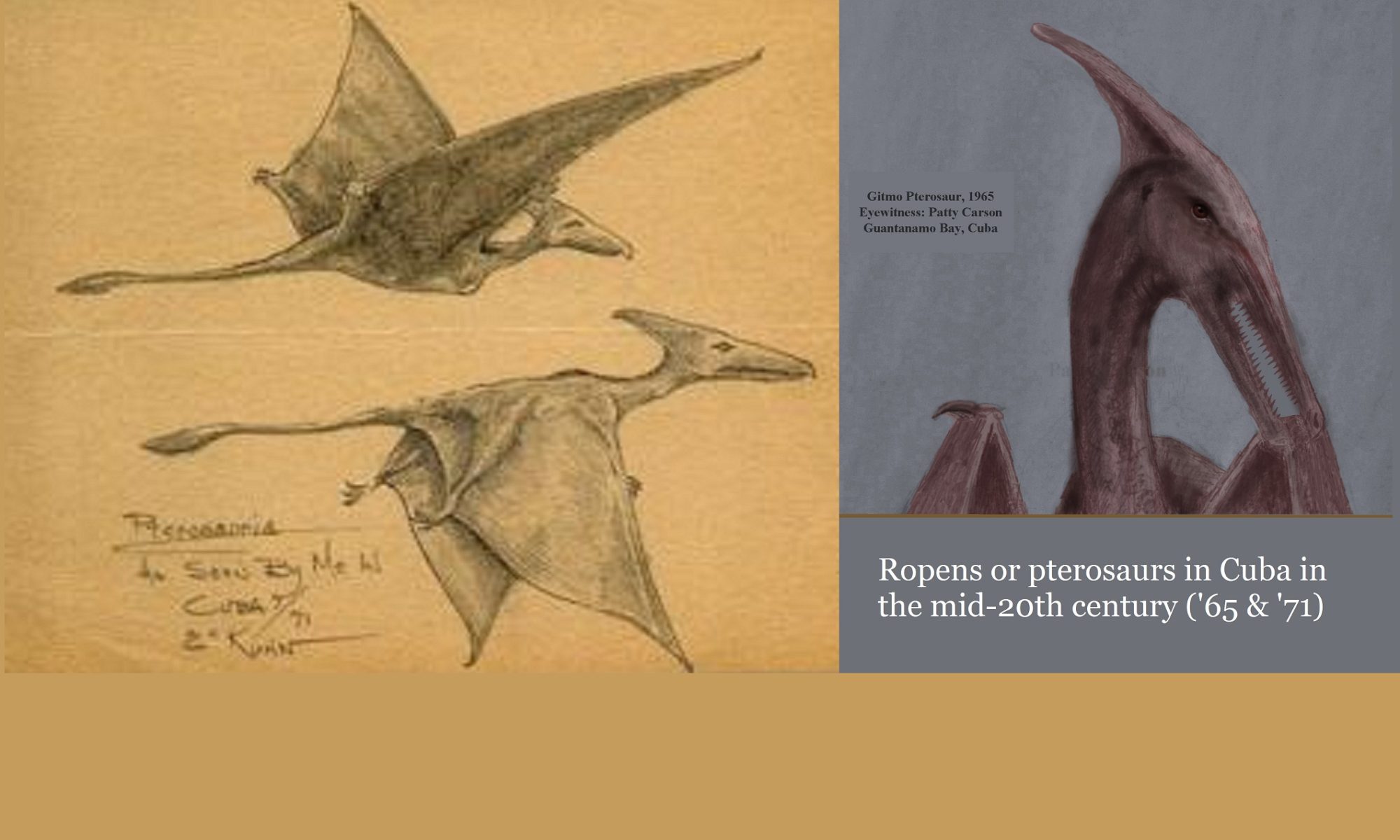
I was around six years old. . . . We were walking down near the boat yards, headed home. . . . where it was sandy underfoot, sparse scrub vegetation around four feet tall . . . suddenly it sat up, as if it had been eating something or resting. . . . It was at about 2 o’clock [probably meaning to the right of where they were heading] right in front of us about thirty feet away. All of us froze for about five seconds, then it leaned to its left and took off with a fwap fwap fwap sound . . .  and flew to its left and disappeared behind trees and terrain.

It did have a tail and it had a diamond shaped tip . . . The skin was a leathery, brownish reddish color. It had little teeth, a LOT of them . . . It was as tall as a man when it stood up on it haunches.

This lady has seen the sketch by Eskin Kuhn and she told me it is very close to the appearance of what she had seen; she told me that she would not make any major change to that sketch other than shortening the tail slightly and lengthening the wings slightly and making the head slightly curved.

One of two pterosaurs that the U. S. Marine Eskin Kuhn saw in Cuba in 1971

“I did interview him [Eskin Kuhn, eyewitness who had drawn this sketched] by phone just a few weeks ago, and I found his response to my surprise phone call truly enlightening: He was highly credible in his manner of speaking and his answers to my unexpected questions. This mature man has not been playing a hoax for four decades, for everything points to an honest reporting of a real experience. In light of many other sightings, by many other eyewitnesses, Mr. Kuhn’s sketch now deserves serious attention.”


Eskin Kuhn, U. S. Marine at Gitmo, Cuba

Eskin Kuhn at Guantanamo Bay, 1971

Gitmo Pterosaur Seen by Kuhn

“I was not stationed to the barracks; but to 2nd Battallion, 8th Regiment (reinforced), H&S Co., 106mm recoiless rifle platoon. . . . It was a beautiful, clear summer day . . . most of the platoon was in the new barracks “hanging out”. I was looking in the direction of the ocean when I saw an incredible sight. It mesmerized me! . . .  I saw two Pterosaurs . . . flying together at low altitude, perhaps 100 feet, very close in range from where I was standing, so that I had a perfectly clear view . . .

“. . .  the texture of the wings appeared to be very similar to that of bats . . . they had a long tail trailing behind with a tuft of hair at the end.”

***

Marfa Lights as Flying Predators

Recently, two glowing pterosaurs were observed flying together in the Caribbean, between Cuba and Haiti. The lady who reported those two flying creatures was not alone in being an eyewitness on that night on her cruise ship; her daughter can corroborate that sighting. At other times, and in other areas of North America, other eyewitnesses have seen large flying creatures that glow at night. At least some of these may relate to the Marfa Light of southwest Texas, for many sightings of apparent pterosaurs come from various parts of Texas.

*************************************************************

Third edition of "Live Pterosaurs in America"

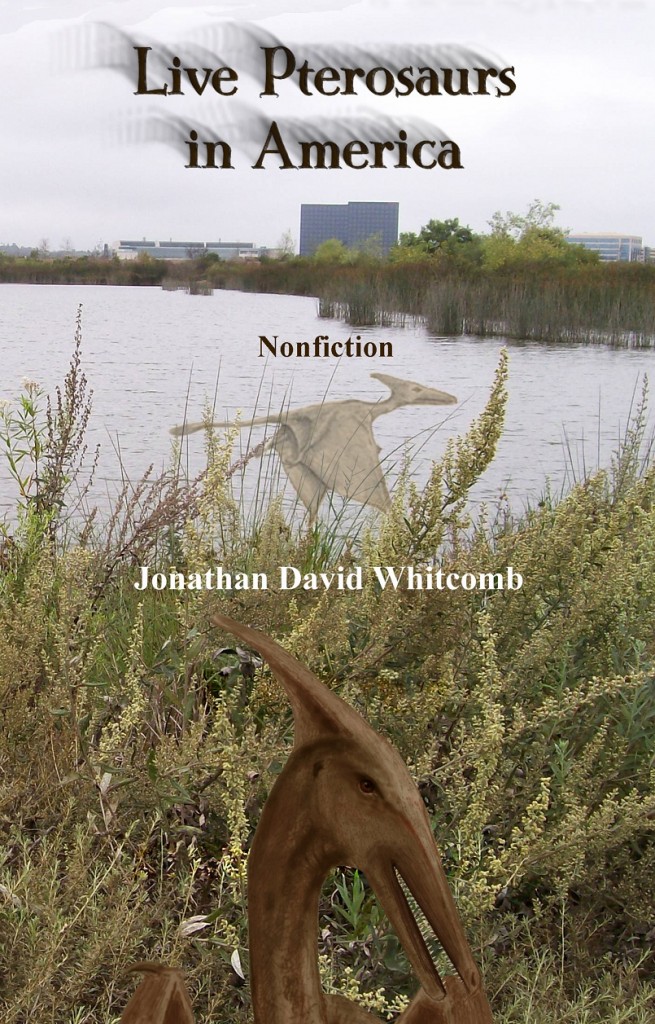
Live Pterosaurs in America, third edition, nonfiction

Read the amazing stories that newspaper editors rarely tell the public: eyewitness accounts of living pterosaurs in the United States of America. Learn for yourself the astonishing secret: These flying creature, many of them huge and featherless and with long tails, are not extinct but still living in North America. How amazing! Live Pterosaurs in America.

This nonfiction cryptozoology book will enlighten you about these living “pterodactyls” that sometimes are seen to fly at night. One chapter is devoted to the Marfa Lights of Texas, but many of the 48 contiguous states of the U.S.A. are included: California, New Mexico, Arkansas, Texas, Oklahoma, Georgia, Florida, South Carolina, Pennsylvania, New York, Ohio, Wisconsin, Kansas, etc. Find out for yourself about the sighting by Eskin Kuhn, the U.S. Marine who witnessed those two pterosaurs in Cuba, in 1971.

How do Pterosaurs Survive the Cold?

Tuesday, March 29th, 2011

I recently received an email from Joan Wilmington, a reader of the second edition of my book Live Pterosaurs in America:

Hi, Jonathan. I just finished reading Live Pterosaurs in America. Fascinating book. I had no idea so many sightings had occurred in the United States. . . . As I read the book, several questions came to mind. I’d love to get your insight on them:

1) How do pterosaurs deal with the cold? I noticed that several sightings were in areas that have very cold winters.  Do you think they are warm-blooded by any chance?  I know at this point, it would only be speculation, but I’m curious.  How do they cope with the cold, without the insulating effects of fur or feathers?

2) Do you think they hibernate or migrate?

I include the second question, for it relates to the first: the challenge of cold winter weather in most of North America. But first we need to consider the rarity of sightings, in relation to common observations of most birds. I agree with Garth Guessman that pterosaurs in the 48 contiguous states are not rare to the point of being in danger of extinction. Hopeful as that idea might seem, we have struggled with the relative rarity of sighting reports, for that kind of rarity gives us limited data to analyze.

I doubt that any other cryptozoologist has a larger collection than I do, of reports of sightings of living pterosaurs in North America; many eyewitnesses have sent me emails, over the past eight years, reporting their sightings. If every report were highly detailed, including details about weather and date-of-sighting, I might come to some conclusion about how modern pterosaurs in North America deal with cold weather; but I do not have hundreds of detailed reports from this part of the world, so I can only apply general common sense: I speculate. But I do have a few details to guide speculation.

But let’s begin by considering well-known animals that must survive cold winters in North America.

How do Bats Survive the Cold?

The Big Brown Bat, Eptesicus fuscus, at about half a pound (see Wikipedia for details on this bat), survives quite well:

[These bats]  hibernate during the winter months, often in different locations than their summer roosts. Winter roosts [are in] . . . caves and underground mines where temperatures remain stable; it is still unknown where a large majority of Big Brown Bats spend the winter. If the weather warms enough, they may awaken to seek water, and even breed. [Wikipedia]

I was struck by how little is known about where most Big Brown Bats spend the winter. If that common bat, with a Conservation Status at the extreme safe side (“Least Concern”), holds that kind of mystery, how easy it is for an elusive uncommon flying creature to keep hidden in winter (when most humans are usually indoors almost all the time, never trudging through any snow-covered wilderness to hunt dragons)! For that reason, I’m not holding my breath waiting for an eyewitness account of a hibernating pterosaur.

How do Reptiles Survive the Cold Winters of Canada?

Many birds escape the cold winters by migrating to warmer places, but, aside from marine turtles, reptiles can’t travel large distances.  Instead, reptiles must either tolerate the cold or go underground or underwater to escape it.

. . . In places where winters are very cold . . . sites where reptiles can get deep enough underground to survive the winter may be rare.  In these cases, hibernating sites may be shared by many animals, and animals may travel from far away to use the site. . . . communal hibernation.

Monarch Butterfly Migration

Four generations are involved in the migratory cycle of the Monarch Butterfly. According to monarch-butterfly.com, the fourth generation “is born in September and October and goes through exactly the same process as the first, second and third generations except for one part. . . . [It] does not die after two to six weeks. Instead, this generation of monarch butterflies migrates to warmer climates like Mexico and California . . . [living] for six to eight months until it is time to start the whole process over again.”

Pterosaur Survival in Winter

We could delve into where and how a mouse or bird or fish survives when the coldness arrives, but the point is this: Small mammals, birds, fish, reptiles, and butterflies survive cold winters (or migrate), so large pterosaurs should have some way to do the same or something similar.

I was about to let the subject drop with that, but you readers who have gotten this far deserve to know something more. In a secret location, monitored by a few cryptozoologists occasionally for a few years, nocturnal flying creatures, apparent pterosaurs, fly in an area of North America where bats are found through at least most of the year. The larger creatures appear to fly in this area during colder weather, at least to some extent. I believe they hunt the bats, but I have not yet been invited to participate in the observations there, so I have still not yet personally encountered a modern living pterosaur. I still hope.

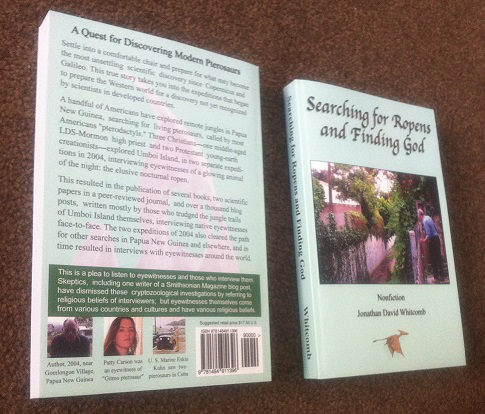
Non-fiction cryptozoology book "Live Pterosaurs in America" - third edition - back cover

Pterosaur Book About to be Published

Thursday, October 7th, 2010

front cover of nonfiction book Live Pterosaurs in AmericaThe second edition of a nonfiction book on pterosaurs, Live Pterosaurs in America, is nearing completion, probably becoming available on Amazon in November, 2010. Several additions to this cryptozoology book make this revised edition more valuable.

Sighting in Cuba

Although the Guantanamo Bay military station in Cuba is not part of the United States, the 1971 sighting report of two long-tailed pterosaurs will be included in the book, for those two flying creatures were very similar to some of those reported by eyewitnesses in the United States, and Cuba is just to the south.

Although the marine, Eskin Kuhn, saw bats in caves, on other days, the two pterosaurs he saw in daylight, on one particular day, were not anything like any giant bat. They had long tails and head crests, an unusual combination according to fossil records of pterosaurs, but similar to many descriptions in reports of sightings worldwide.

Texas Pterosaur

For many years, eyewitnesses have reported live pterosaurs in Texas, and the new edition of Live Pterosaurs in America has new sighting reports from that state. Most extraordinary, one chapter, new to this edition of the book, is titled “Marfa Lights of Texas.” How do those strange dancing lights in southwest Texas relate to sightings of apparent pterosaurs? Consider these brief excerpts from the book.

Mr. Bunnell the scientist, has lived around Marfa, Texas, for much of his life. . . . (James Bunnell, apparently, knew nothing about ropens in New Guinea; he considered only Marfa Lights interpretations involving light-sources non-living. I communicated with him by emails, early in 2010.)

[His automatic camera] recorded time-exposed photographs of a light flying west . . . The light resembled rapid on-off states of chemical combustion: starting to burn, almost dying off, then starting up again, with occasional outbursts of greater intensity. Nothing in Bunnell’s description of this event contradicted what might be expected of a ropen-like flying creature periodically secreting something that causes extreme bioluminescence.

On May 7th and 8th, 2003, extraordinary events were photographed . . . I was intrigued at Bunnell’s description of how those two lights behaved, for it seemed consistent with my hypothesis that Marfa Lights are made by flying predators with extreme bioluminescence like the ropen of the Southwest Pacific but used for a different purpose: to attract insects that attract the Big Brown Bat.

Third edition of "Live Pterosaurs in America"

Live Pterosaurs in America, third edition, nonfiction

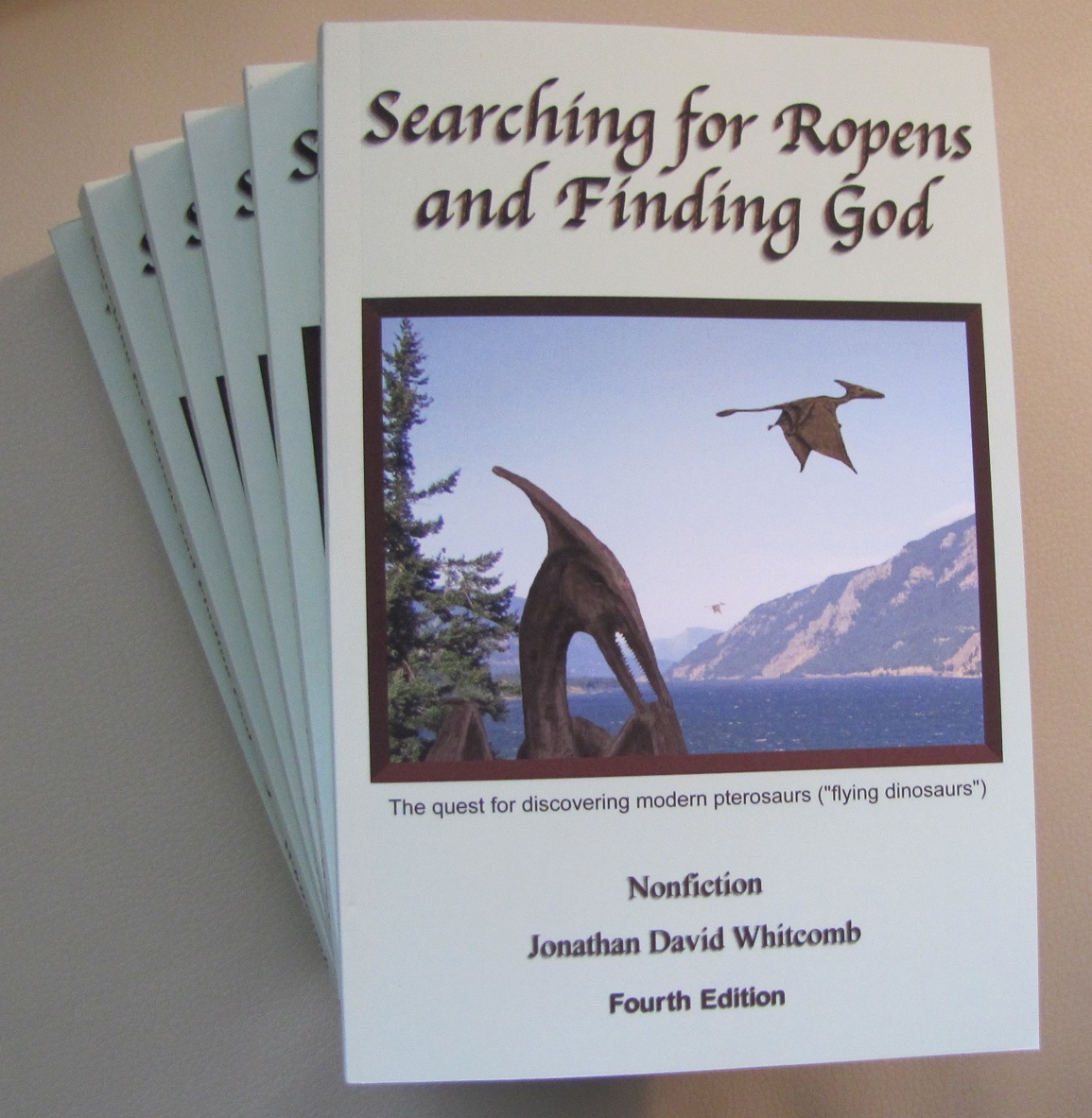
The third edition of Live Pterosaurs in America was published early in November, 2011: updated and with a wonderful new sighting report from Cuba. Buy your own copy of this incredible nonfiction cryptozoology book.

Apparent Pterodactyloid in Southern California desert

Tuesday, August 10th, 2010

From the nonfiction cryptozoology book Live Pterosaurs in America, we read of a startling sighting in a remote California desert:

We were sitting in the late afternoon shade of a ridge, on lawn chairs, enjoying the solitude and peace and quiet of the desert when it passed over. I caught the sight of it with the corner of my eye and looked up. It was soaring along the side of a plateau not far from us . . . I remember saying ‘. . . that looks just like a Taradactyl!’ . . . My friend looked in the binoculars and said it looked like one but it had to be a kite or something because they were extinct. . . . I grabbed the binoculars . . . What I saw was large and very much alive. Its hue was close to the hue of the desert sand but more the color of rust. Its skin, I say skin because there were no feathers, . . . looked like dull leather sort of dusty looking. . . . The back of the head was pointed.

[From page 16 of the first edition of the book] I interviewed this eyewitness and questioned her about details. She answered thoroughly, demonstrating her credibility. I have communicated with her since that 2007 interview and she maintains the truthfulness of her account; I have no reason to doubt her experience. This sighting seems to have been of a Pterodactyloid pterosaur, for it had no tail: only “a nub where a tail would be.”

Switch to our mobile site