
Live Pterosaur

|

Investigating Reports of Living Pterosaurs, by Jonathan Whitcomb

Recent Pterosaur Sightings Near Griffith Park, Los Angeles

May 21st, 2013

The most recent California pterosaur sighting report that I have received is from a flyover of Interstate-5, on May 13, 2013, just southeast of Griffith Park. It was south of Los Feliz (at the I-5), in Los Angeles, just a mile and a half south of where another eyewitness observed three “dragons” flying over the same freeway, two months earlier. That stretch of highway runs very close to the Los Angeles River channel. I feel that neither of those factors is a coincidence.

North^

satellite map of the eastern side of Griffith Park in Los Angeles

Eastern side of Griffith Park (Silver Lake Reservoir is on lower right)

.

In the above satellite image, the I-5 runs right next to the Los Angeles River channel, on the east side of Griffith Park. They run about north-south here, with the large hills and golf course of Griffith Park visible clearly. Another freeway runs east-west near the northern boundary of the park, near the top of the photo. By the way, this area is just north of Dodger Stadium (baseball).

Before getting into the more recent sighting (May 13th), consider the three “dragons” observed nearby, on March 3rd.

.

satellite image of sighting location of three "dragons" just east of Griffith Park, Los Angeles, California, early in 2013

March 3rd sighting location (three “dragons”)

.

The red arrow, above, shows the direction of flight for the three creatures that the eyewitness called “dragons.”

First Griffith Park Sighting of Early 2013

I name this anonymous lady “CGP.” At about 6:10 a.m., on March 3, 2013, the sky was well lit, although the sun had not quite come up. As CGP was driving north on the I-5, at around the Colorado interchange (just south of State Route 134 freeway), she saw three “dragons” and later reported to me:

“They appeared to be several feet long, with a head:body:tail ratio that was certainly not that of a bird. Their wings were long, angular and pointed and their tails had triangular points. . . . They were flying southeast in a triangular formation.”

I later drew an arrow pointing south (see the satellite map above) because of the following words of CGP:

“All three were flying straight at me, opposite the flow of traffic, along the freeway. I guess they were going slightly more in the direction of Griffith Park than Glendale, but they flew directly over my car (or I drove under them).”

.

On May 13, 2013, an eyewitness driving north on the I-5 freeway in Los Angeles, California, saw a pterosaur fly overhead, towards Glendale

May 13th sighting location (one “pterosaur”)

.

Second Griffith Park Sighting of Early 2013

The eyewitness of a “pterosaur” sighting on May 13th has agreed for her name to be revealed: Devin Rhodriquez. The traffic on the northbound I-5 at about 4:00 p.m. was congested, about 30 m.p.h., when Devin saw the creature. She told me (standard capitalization corrections):

“I’m almost positive what I saw fly over the freeway in Los Angeles WAS NOT a bird of any kind. [It] matches the exact descriptions of a pterosaur except for the tail. I didn’t actually look for a tail [She did not notice its presence or absence]. I was too in shock by the head crest and the wings. I’d love to find out if what I saw could be a pterosaur.”

I realize that some skeptic may object to the lack of observational powers of the eyewitness, regarding a tail of lack thereof. But this kind of imperfection in observation is actually quite common, a natural human tendency to focus on a detail to the blindness of surrounding details. I have received pterosaur sighting reports from other eyewitnesses, reports that make it clear that the person had not memory of the presence or absence of a tail. And psychologists are well aware of this human weakness in vision.

Consider what Devin did notice:

“I did see its head crest and the membranous charcoal gray/teal undertone skin. No feathers, & the wings were pointed and never flapped. It glided through the air with its wings in an arched position.”

Comparing the two Sightings

The creatures were flying in very different directions in these two sightings, and the times of day varied greatly as well: The first was at 6:10 a.m. the second, 4:00 p.m. The two eyewitnesses noticed different details: The first saw long thin tails on three “dragons;” the second, a head crest and a lack of feathers.

What did the flying creatures have in common? The sightings were only a mile and a half apart, separated in time by ten weeks. Both eyewitnesses were driving north on the I-5 freeway, just east of Griffith Park in Los Angeles. All the creatures were soaring or gliding over that freeway.

The color descriptions caught my attention. CGP said, “They appeared light in color—white, gray or light green.” Devin said the “pterosaur” had ”membranous charcoal gray/teal undertone skin.” Technically, teal is a medium-dark bluish green, but the different times of day (with very different colors of light from the sky) might be sufficient to connect that darker blue-green with the lighter green, provided we remember that eyewitness perception may cause the same object to be described slightly differently in color. In addition, both eyewitnesses used the word “gray” in their color descriptions. I know that “white” seems too far off when compared with “charcoal,” but we also need to be aware that the two eyewitnesses may not have noticed the exact same parts of the flying creatures’ bodies when they were impressed with color. Overall, the color descriptions neither greatly support nor repudiate the idea that these two sightings involved the same species. With all that said, we may have a case of three light-colored males and one darker colored female.

Both eyewitnesses assured me that they were observing non-birds. CGP said, “a head:body:tail ratio that was certainly not that of a bird.” Devin said, “I’m almost positive what I saw fly over the freeway in Los Angeles WAS NOT a bird of any kind.”

I suggest these four flying creatures are all California Ropens, and that they sometimes fly along the Los Angeles River at night. Many eyewitnesses have noticed them, with various degrees of comprehension but only a tiny fraction of those people have contacted any cryptozoologist.

###

.

Dragon Pterosaurs in Southern California

The eyewitness of the “Griffith Park dragons” first thought she was observing three non-living things flying over her car [March 3, 2013 sighting] . . .She assumed it was some kind of stunt, perhaps with kites, for the three “dragons” looked nothing like birds. When she saw the tails move slightly, she realized that they were alive.

.

Ropen Expeditions of 1994 and 1996

May 17th, 2013

We have been awed by eyewitness reports from recent years; but we must not forget those who made possible recent investigations: The explorers of the 1990′s who searched for the ropen and interviewed native eyewitnesses in Papua New Guinea. Without those expeditions in 1994 and 1996, where would we be? Without Carl Baugh’s early expeditions, we would not have had Paul Nation’s expedition in 2002 nor my expedition in 2004 nor Guessman and Woetzel’s, also in 2004. Without Carl Baugh interviewing natives in the 1990′s, we would not have had the historic 2006 expedition by Paul Nation nor the Destination Truth expedition of 2007. Without Carl Baugh, we would not now have the live-pterosaur branch of cryptozoology nor the word “ropen” on Wikipedia. Baugh opened the door for these investigations.

Paul Nation accompanied Baugh and missionary James Blume in the 1994 expedition but not the one in 1996. He sent me his video footage in the fall of 2003, and I edited the videos into a mini-documentary that we called “Searching for Ropen.” But those original videos did more for me that provide material for a mini-documentary: They inspired me to go on my own expedition in 2004, searching for living pterosaurs.

The following are brief summaries of some of the early interviews (mostly 1994).

Tree-Trunk Hugging Ropen

Two native men were interviewed briefly, possibly by Baugh himself (through an interpreter) with videotaping by Paul Nation, perhaps. The two men reported how they had strung up some game meat and later encountered a ropen that they believed had followed the smell. The creature held itself upright on a tree trunk and looked down at the men by turning or twisting its head or upper body.

In the 1990's, native eyewitnesses were interviewed by American Carl Baugh and missionary Jim Blume. This native saw a ropen hanging onto a tree trunk.

Native shows how the ropen was upright, holding onto a tree trunk

.

Another videotaped interview (probably also from the 1994 expedition) involved a native man who was shown an illustration of a pterosaur. The man said that they see those creatures and that they catch fish and live in caves.

This native eyewitness (left) was interviewed by missionary Jim Blume, concerning the ropen of Papua New Guinea, around Umboi Island

Native tells interviewer that the creatures catch fish

.

Attempted Grave Robbery in 1993

Carl Baugh interviewed a young family regarding a sighting on the northwest coast of Umboi Island. The husband, a school teacher, interpreted for his wife. She was part of a funeral procession, in 1993, around the northwest coast of Umboi, when a flying creature with a glowing tail approached the body. The mourners chased the creature away, but the memory would not leave.

.

In the 1990's, one of the native eyewitnesses interveiwed on Umboi Island was Eunice, who saw the glowing creature fly towards a funeral gathering

School teacher interprets for his wife, who saw the glowing ropen one night

.

First Videotaped Interview, in 1994, of Gideon Koro

Gideon was just a teenager in 1994, when he was first interviewed in front of a video camcorder. He was nervous talking about the giant ropen, for it had been only a few months or so since the terrifying encounter. The Baptist missionary from the mainland, Jim Blume, and a native interpreter questioned the boy about what he had seen.

The creature was skinny and its size was “house to house.” Some time after I had watched the original video footage, I came to realize what he probably meant: The flying creature was as long as the distance from one nearby village hut to the next hut.

When I myself interviewed Gideon, face to face in 2004, he told me that the length of the tail was seven meters. He was positive, in my interview with him, that the ropen had no feathers.

Gideon Koro being interviewed on Umboi Island, Papua New Guinea, in 1994, concerning his encounter with a giant ropen pterosaur

Gideon Koro was interviewed on Umboi Island in 1994

.

Ropen Expedition of 1996

I don’t know if anyone has any video footage from the 1996 expedition. Carl Baugh and Jim Blume may have visited more than one island in Papua New Guinea that year. They had one sighting of an apparent ropen as it was glowing at night; it was not flying but sitting above a beach, on the coast of a small island.

.

###

.

Wife of a school teacher saw a glowing ropen

“Eunice, a school teacher’s wife, described to Carl Baugh an  attempted grave robbery. One night, in April of 1993, near the  northwest coast of Umboi Island, after a large funeral procession  arrived at the burial location, a creature with a glowing red tail came  from the sea. . . .”

.

Third Edition of Searching for Ropens

May 14th, 2013

The expanded and improved third edition of my first book will be retitled: Searching for Ropens and Finding God. From the first edition, this has been a cross genre, a spiritual true-life-adventure cryptozoology book. The new title makes that fact more clear: This is about more than just modern pterosaurs.

Lake Pung Ropen Sighting

The following is taken from the May 14, 2013, version of the editing of the second chapter. It involves Gideon Koro’s first videotaped interview on Umboi Island:

Gideon’s testimony overshadowed the others. He was one of seven boys who saw a giant ropen, around 1994, flying over a crater lake; the boys ran down off the mountain, terrified. Within few months, Gideon answered questions in front of a video camcorder, nervously. He described the ropen as skinny, and the size as “house to house” (referring to nearby huts). One of the two interviewers, Baptist missionary Jim Blume, interpreted: “about twenty feet.” But he misunderstood.

The number of creatures then became confused with size. As Jim Blume was interpreting and estimating the wingspan, it sounded like Gideon mentioned additional “smaller ones.” The interpreters then questioned him about “how many” (meaning the number of creatures), and Gideon answered, “ten or twenty.”

I would discover, after interviewing Gideon myself in 2004, that he did not mean that there were ten or twenty ropens; he was probably adjusting, during the first interview, his size-estimate for the one ropen he encountered. But I would conclude, in 2007, that the median of ten and twenty—fifteen—was the approximate overall length or wingspan of that ropen, in meters, consistent with his estimate of wing-size during my interview with Gideon in 2004: seven meters.

We need to understand that Gideon thinks in meters rather than feet. When the subject was the size of the ropen observed by those seven boys, Jim Blume said “twenty.” Gideon then said something that was interpreted as “smaller ones.” What he meant, I believe, is this: The length or wingspan (probably similar in size) could have been smaller than twenty meters, less than sixty-six feet.

By the way, my memory of villages on Umboi Island may be instructive. I believe many of the huts are in the neighborhood of fifteen meters apart, which is what I believe Gideon meant when he estimated the size of the ropen with the words “house-to-house.” The interpreter may have thought about house length.

.

Publication of Searching for Ropens and Finding God

I hope this third edition will be completed and published by the end of summer.

###

.

A related book but in pure cryptozoology genre:

Cover, back and front, of Live Pterosaurs in America - nonfiction book

Live Pterosaurs in America, third edition, by Jonathan David Whitcomb

This book about modern living pterosaurs is available now, in contrast to Searching for Ropens and Finding God (which will not be published until around September of 2013). From the middle of the introduction, we read:

If this book does nothing more than comfort the eyewitnesses of strange creatures, I would be grateful; but there’s much more. We need to understand why we believe what we believe. When I first began researching these eyewitness sightings, years ago, I mentioned a word to a kindergartner: “pterosaurs;” he said, “A comet.” Years later, while writing this book, I mentioned my work to a second-grader; she said, “Who will buy your book? Crazy people?” I think better of you. And I think, because of what she and many others have told me, that we must understand indoctrination, for it influences our beliefs; the extent of that influence discomforts me.

Purchase your own copy of Live Pterosaurs in America — available now.

Why are Some Living Pterosaurs Huge?

April 25th, 2013

Actually relatively few modern pterosaurs grow to become as large as the largest of those flying creatures known from fossils. At least some species probably continue to grow as long as they live, making the giant ones rare, for many things can cause an organism to die; remember the greatest risk one faces in old age: death. Statistics make it clear that pterosaur sightings, at least the more credible reports, show a steady range of wingspan estimates, with a slight drop off in the flying creatures appearing to have a wingspan greater than about thirty feet. Let’s examine that idea first.

Why do so many sightings involve giant pterosaurs?

That’s a better question, for the giant ones are indeed rare. What do I mean? Put yourself in the following situation, and let’s say that you are unaware of reports of living pterosaurs. Walk out your front door to your car as something flies over your house. Whatever that something is, let us say it’s over a hundred feet high and between the size of a sparrow and a crow. Would you look up to see what kind of bird it is? Why bother?

Now keep everything the same except the size: The flying creature has a wingspan of twenty feet. Even at 150 feet above your house, it could very well catch the corner of your eye and perhaps change your life, as you turn your head. Our subconscious has a way of telling us when something is odd.

The point? Modern pterosaurs with wingspans greater than large birds catch the attention of eyewitnesses, even though those larger ones are nocturnal and relatively rare. When one of them takes off into the air in daylight, for whatever reason, how easy we can take notice! That shocking appearance might also increase an eyewitness’s desire to report the sighting to me, increasing the number of giant flying creatures in my reports.

If we could take a census of all modern pterosaurs, of all species now living, I would not be shocked to learn that less than 1% of them have wingspans over twenty feet. Take that in the context of the late-2012 analysis of the 128 most credible sighting reports: Of those estimating wingspans, 26% of the estimates were over twenty feet. But I would guess the actual number of animals (of that size) at much closer to 1% of the total population.

.

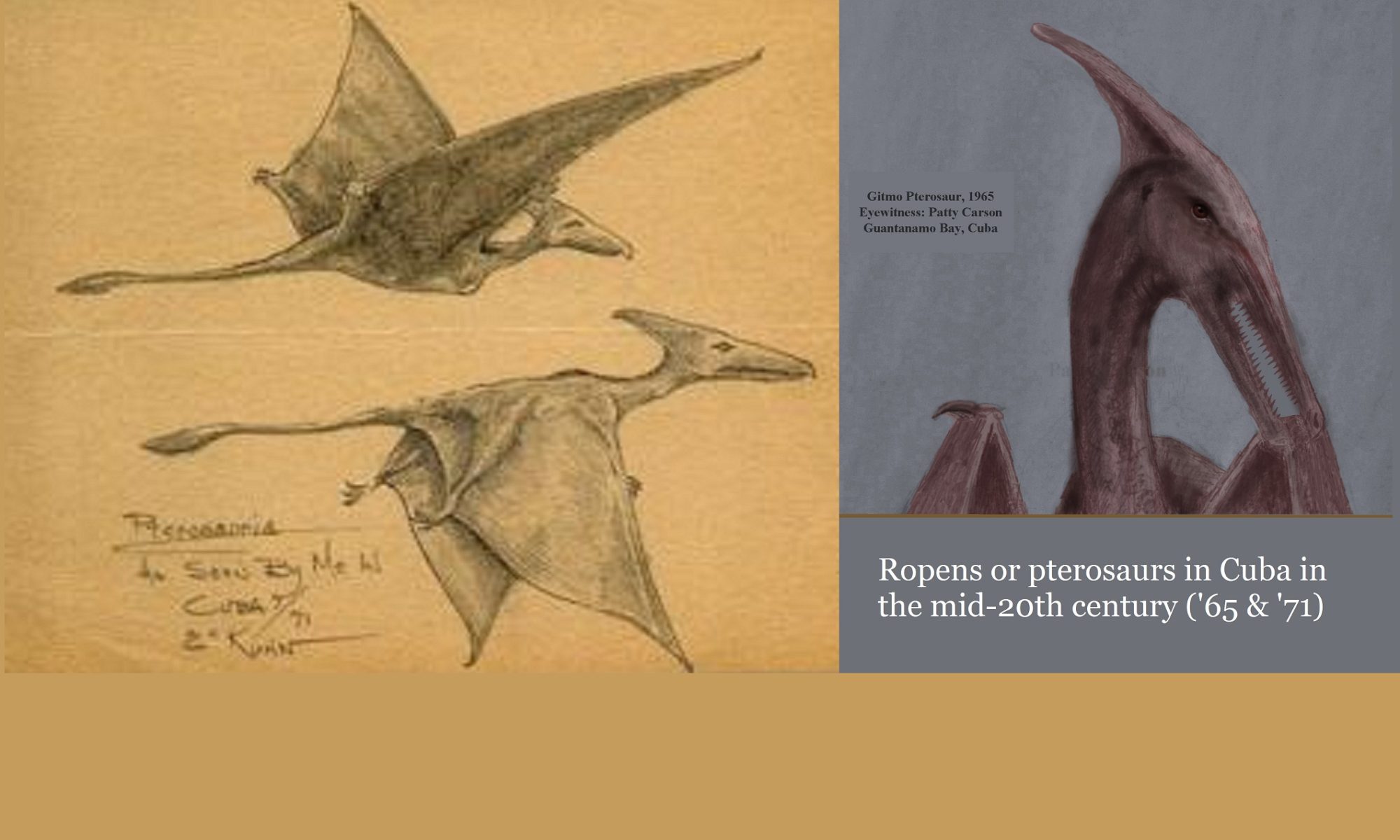
Perosaur Sketch by Eskin Kuhn

Kuhn saw two pterosaurs in Cuba, in 1971

.

Pterosaur Sightings and Photos

Direct eyewitness testimony of a pterosaur sighting is essential, even if we have to wait many years for photographic evidence.

Was it a Giant Prehistoric Bird?

. . . why is that word  used by some eyewitnesses: “bird?” That word comes to mind because birds commonly fly overhead, during the daylight when we notice things in the sky, far more commonly than we notice bats.

Live Pterosaurs and Science

What can we conclude from the evenness of the data on wingspan estimates? No significant number of hoaxes were involved, for expectations regarding pterosaur size would have made one or two peaks; there is no significant peak anywhere that would suggest such a thing.

Switch to our mobile site