Live Pterosaur
Media Center
Press Room for News Releases
Pterodactyl Reported in Papua New Guinea
A
study
by
an
American
cryptozoologist
suggests
that
the
"pterodactyl"
described
by
the
World
War
II
veteran
Duane
Hodgkinson
was
a
real
creature, of a species living in coastal areas of Papua New Guinea. . . .
Whitcomb
disputes
the
idea
that
sightings
of
giant
“pterodactyls”
are
only
misidentifications
of
Flying
Fox
fruit
bats.
.
.
.
the
ropen
is
said
to
eat
fish
and to have a long tail, unlike the Flying Fox. . . .
Glowing Creatures Videotaped In Papua New Guinea
A
physicist
[Clifford
Paiva],
who
examined
video
footage
of
two
strange
lights
that
explorers
think
are
bioluminescent
pterosaurs,
declares
that
the
glow
is
not
from
meteors,
lanterns,
campfires
or
an
airplane.
Paul
Nation,
of
Granbury,
Texas,
videotaped
the
lights
one
night,
in
November,
2006,
in a remote mountainous area of the mainland of Papua New Guinea. . . .
Paul
Nation's
2006
sightings
make
his
expedition
stand
out
from
all
previous
living-pterosaur
expeditions
from
1993
through
2004.
He
saw
eight
flights
of
the
nocturnal
creatures:
low
altitude
over
the
mountain
ridges, far northwest of Port Moresby . . .
Reports of living pterosaurs in the U.S.A. not hoaxes
"Hoaxes
are
disproved,"
declares
Jonathan
Whitcomb,
author
of
the
nonfiction
book,
"Live
Pterosaurs
in
America."
After
compiling
data
from
reports
collected
from
early-2004
to
mid-2009,
from
eyewitnesses
across
the
United
States,
he
found
three
kinds
of
evidence
disproving
any
hoax
explanation.
Pterodactyl-like creatures on New Britain Island
Leathery-skinned
creatures
with
pointed
head
crests
and
bird-like
beaks
fly
over
the
interior
of
a
tropical
island
in
Papua
New
Guinea,
according
to
three
American
eyewitnesses
who
worked
in
a
medical
mission
there.
With
wingspans
estimated
between
eight
and
twelve
feet,
the
pterosaur
like
creatures
are
said
to
glide,
in
daylight,
over
valleys
in
central
New
Britain Island . . .
Unmasking a Flying Predator in Texas
For
generations,
the
mystery
lights
of
Marfa,
Texas,
have
entertained
residents
with
their
strange
dancing.
On
some
warmer
nights,
a
ball
of
light
seems
to
split
into
two,
which
will
separate
and
fly
away
from
each
other
before
turning
around
and
flying
back
together.
They
have
recently
been linked to flying lights in the southwest Pacific . . .
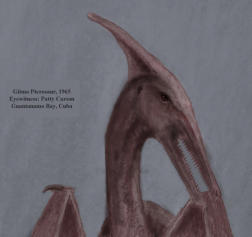
Pterodactyl in mid-20th-Century Cuba
Two
large
long-tailed
flying
creatures,
apparent
pterosaurs,
caught
the
Marine’s
attention.
He
later
reported
that
they
were
“flying
together
at
low
altitude,
perhaps
100
feet,
very
close
in
range
from
where
I
was
standing,
so
that
I
had
a
perfectly
clear
view
of
them.”
.
.
.
He
had
no
idea
that
anybody else had seen such a creature. [sighting by Eskin Kuhn]
A Psychologist saw a Living Pterosaur
A psychologist who sometimes works for the Chongqing University of
Medical Sciences in Central China has declared that he saw a prehistoric-
looking creature flying in New Guinea. . . .
###
Press Releases in 2013
The opinions here expressed are those of Jonathan David Whitcomb.
Media professionals are welcome to use these paragraphs in whole
or in part for news distribution. All of the images on this page may also
be used by the news media.
Contact:


Other Press Releases

Press Releases in 2014

ver-42