Live Pterosaur
Media Center
Downloadable images
available for media use:
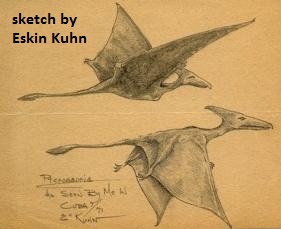
Two pterosaurs reported at Guantanamo Bay,
Cuba, in 1971, by U.S. Marine Eskin Kuhn -
More on Gitmo Pterosaur

Duane Hodgkinson, World War II veteran who
saw a “huge” “pterodactyl” in New Guinea in
1944, at close range and in clear daylight -
More on Duane Hodgkinson

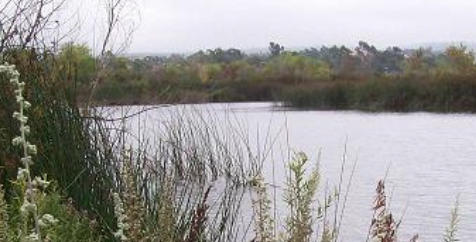
Gideon Koro, of Umboi Island, Papua New
Guinea told Jonathan Whitcomb, “it came
down” and flew over Lake Pung (mid-day) -
More on Gideon Koro

Wesley Koro was one of seven boys who
hiked up to a crater lake around 1994, and
were terrified from a ropen encounter -
More on Wesley Koro

Mesa Agustin was nervous talking about
what he and his friends saw flying over
Lake Pung about ten years earlier -
More on Mesa Agustin

As a forensic videographer, Jonathan D.
Whitcomb interviewed eyewitnesses on
Umboi Island, in Sep-Oct of 2004 -
More on Whitcomb Expedition
A New Branch of Cryptozoology:
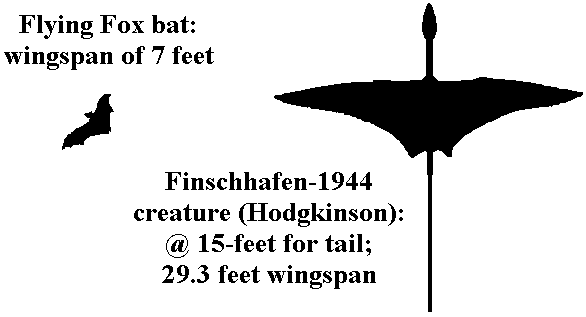
Comparing large fruit bat to Hodgkinson
creature: misidentifying a Flying Fox is
not the answer for this sighting -
More on fruit bats and pterosaurs


Abram, of Opai Village on Umboi Island,
told Whitcomb about how the ropen light
flew out to a reef, like it was fishing -
More on Abram of Opai
David Mokay, of Opai, told Whitcomb about
a flash of bright light that lasted about five
seconds. No form or shape was seen -
More on David Mokay

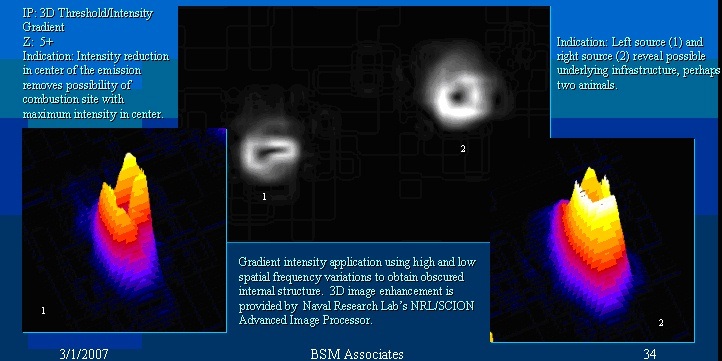
Missile defense physicist analyzed video of
two mysterious flying lights, without any
commonplace explanation -
More on video analysis
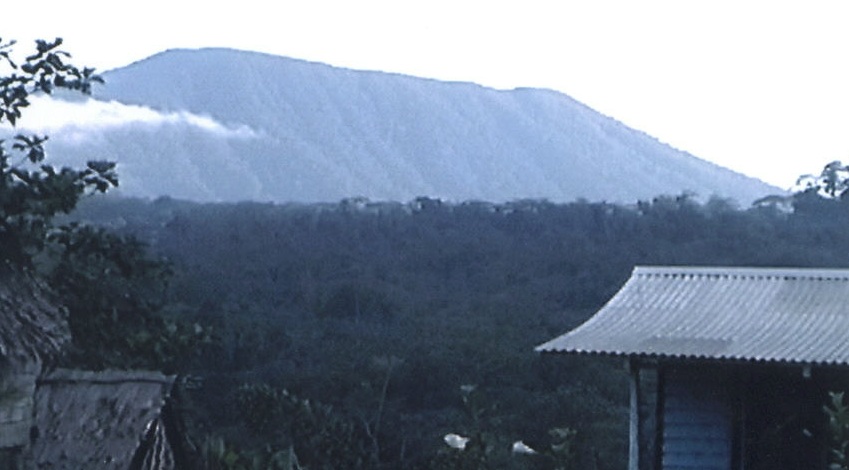
Mount Swal, Umboi Island, where the ropen
light is sometimes seen to fly on some nights -
More on flying lights on Umboi Island

At Lab Lab Village, Umboi Island, Steven
Cottingham, a government official, saw the
ropen light for himself -
More on
Cottingham sighting

Since 2004, Jonathan David Whitcomb has
received direct reports from eyewitnesses
from around the world: live pterosaurs —
More about Jonathan Whitcomb
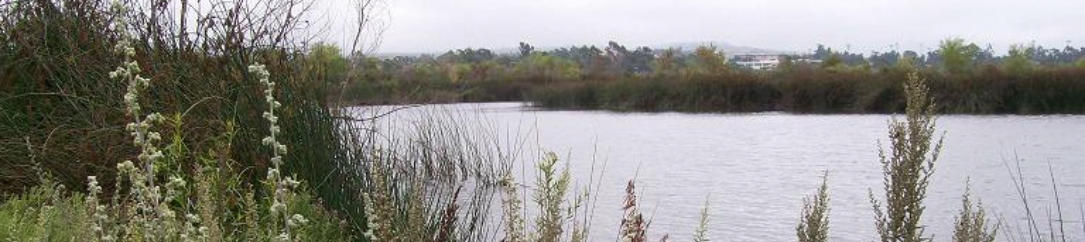
Finschhafen Harbor, near where the World
War II veteran saw the huge “pterodactyl” -
More on Finschhafen
Scientific Papers in peer-reviewed journals
of science, on reports of living pterosaurs
For those images available for use by news media, left-
click on an image, then, in the new window, right-click
on the image and select “save as . . .” to your computer
(this may vary according to the web browser used).
Live Pterosaurs
Press Room: pterodactyl, flying dinosaur,
prehistoric flying creature, dinosaur bird,
dragon, primitive featherless bird . . .
More downloadable images
available for media use:
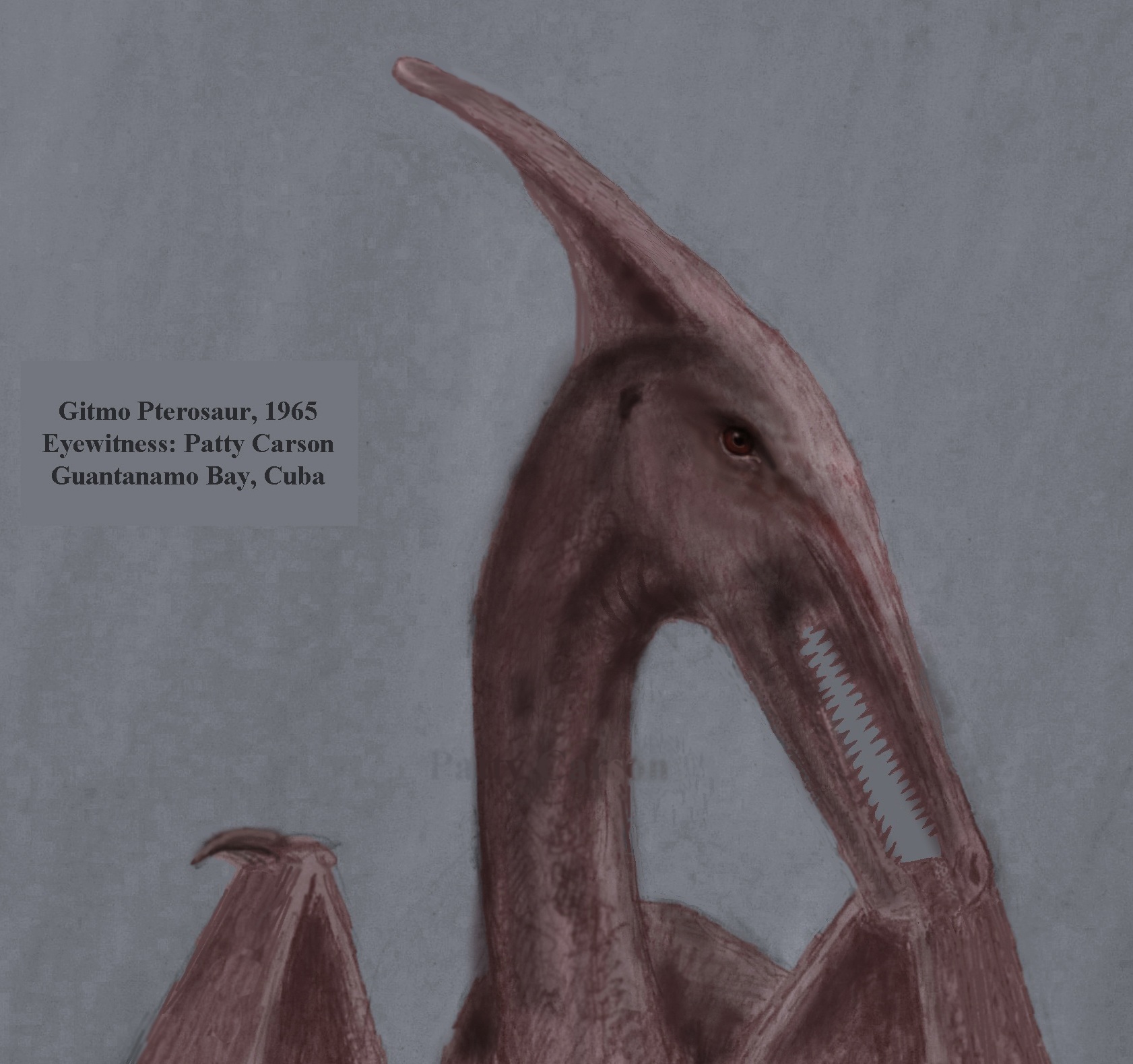
Patty Carson, in mid-2011, sketched the
flying creature that she saw at Gitmo, in
Cuba (Guantanamo Bay military base)
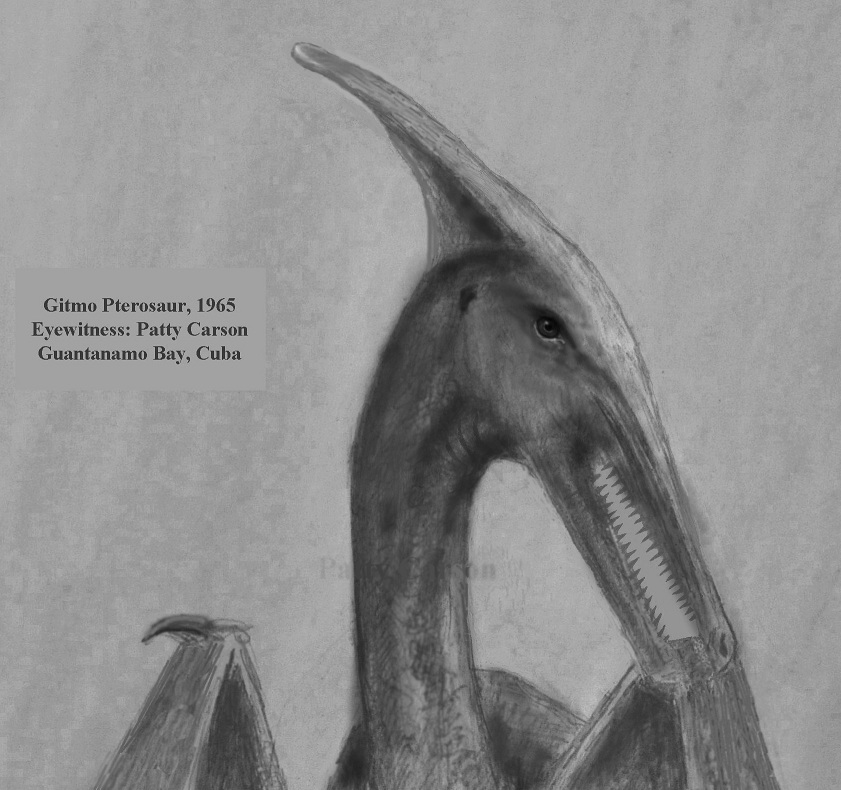
Medium-large B-W image for print media

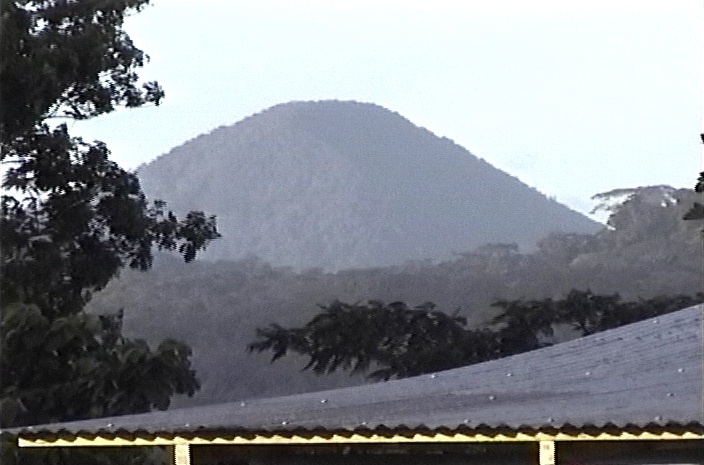
Mount Barik, where the ropen is reported
to fly as it glows, including late in 2004
“One clue [about what kind of flying creature
is this Orang-bati] is in the tradition about
capturing young humans. Those storiesare also
found in Papua New Guinea. The indava flying
creatures, seennear Tawa Village, deep in the
interior of the mainland of PNG, are said to
have carried away children and pigs from the
villagers, in the past”.
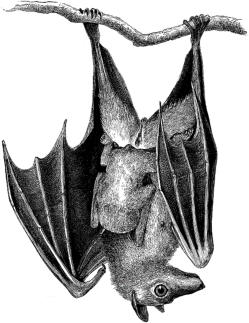
“Misidentified fruit bat” has been found to
be an inadequate explanation for sighting of
long-tailed pterosaurs in Papua New Guinea
and other areas of the southwest Pacific. The
above image represents a fruit bat.
Introduction to Living Pterosaurs
In
the
book
The
Illustrated
Encyclopedia
of
Pterosaurs
,
Dr.
Peter
Wellnhofer
devotes
two
pages
to
the
extinction
of
pterosaurs
and
mentions
the
“paucity
of
the
fossil
record,
especially
for
pterosaurs.”
But
the
rarity
of
those
fossils
opens
up
a
concept
most
paleontologists
have
never
dreamed
of:
Maybe
some
pterosaurs
never
became
extinct,
for
how
can
any
scientist
make
any
sound
conjecture about the extinction of species for which there is no fossil evidence?
Contrary
to
what
many
paleontologists
believe,
some
cryptozoologists,
including
Jonathan
Whitcomb
of
Murray,
Utah,
believe
that
one
or
more
species
of
pterosaurs
are
still
living,
although
most,
at
least,
seem
to
be
nocturnal
and
uncommon.
For
fifteen
years,
Whitcomb
has
gathered
and
analyzed
eyewitness
reports
from
around
the
world,
including
North
America.
He concludes that a number of species of pterosaurs may still live on the earth.
Expeditions in Papua New Guinea
In
2004,
he
explored
part
of
Umboi
Island,
Papua
New
Guinea,
and
interviewed
many
native
eyewitnesses
of
the
flying
light
that
they
call
“ropen.”
Just
before
he
left
the
island,
he
found
four
eyewitnesses
of
more
than
just
a
distant
light.
Gideon
Koro,
his
brother
Wesley,
and
their
friend
Mesa
had
been
terrified
by
the
huge
flying
creature
that
flew
over
the
surface
of
Lake
Pung,
in
daylight,
about
ten
years
earlier.
In
addition,
Jonah
Jim
also
saw
the
wings
and
the
long
tail of the glowing
ropen
, at close range, one evening.
A
few
weeks
after
Whitcomb’s
expedition,
other
American
cryptozoologists
explored
Umboi
Island.
David
Woetzel,
of
New
Hampshire,
and
Garth
Guessman,
of
Southern
California,
confirmed
the
native
accounts
of
a
bright
glow
that
the
Americans
attributed
to
the
bioluminescence
of
a
large
flying
creature.
Woetzel
and
Guessman
used
detailed
questionnaires,
including
one
page
of
silhouette
sketches
of
birds,
bats,
and
pterosaurs.
Two
of
the
native
eyewitnesses
had
close
enough
views
of
the
ropen
to
give
reliable
responses
to
those
thirty-four
silhouettes,
and
both
Jonathan
Ragu
and
Jonah
Jim
chose
the
one that represented the
Sordes pilosus
, a
Rhamphorhynchoid
pterosaur.
After
returning
to
the
United
States,
Whitcomb
wrote
many
web
pages
and
several
books,
including
Searching
for
Ropens
and
Finding
God.
Many
Americans
then
found
his
web
pages
and
told
him
about
their
encounters
with
similar
flying
creatures
in
North
America,
including
many
states
of
the
USA.
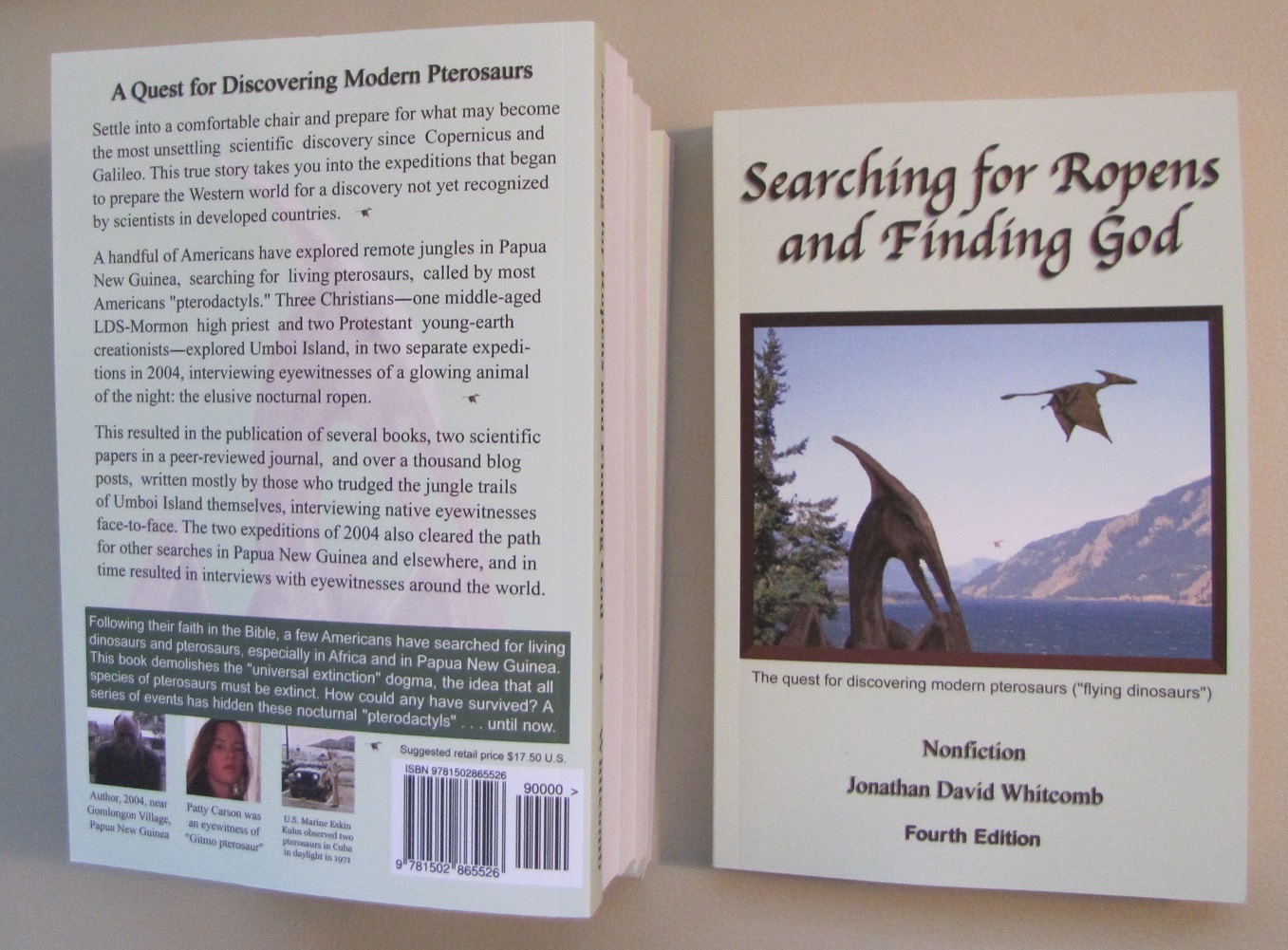
He then wrote the book
Live Pterosaurs in America
.
Sightings of Apparent Pterosaurs in the United States
In
a
2009
press
release
,
Whitcomb
declared
that
at
least
1400
Americans
have
seen
a
living
pterosaur
between
1980
and
2008.
In
recent
years,
however,
he
has
concluded
that
1400
was
a
gross
underestimate.
This
cryptozoologist
continues
to
receive
reports
directly
from
eyewitnesses
in
the
USA,
and
he
declares
that
a
significant
minority
of
the
emails
refer
to
other
eyewitnesses
who
have
not
been
in
touch
with
him.
He
thus
concludes
that
the
total
number
of
Americans
who
have
encountered
an
obvious
living
pterosaur
is
many
thousands. Yet only a tiny minority of them ever contact a cryptozoologist.
The
December
19,
2010,
edition
of
the
Houston
Chronicle
included
an
article
on
Whitcomb’s
conjecture
about
the
Marfa
Lights
of
western
Texas,
quoting
an
engineer
(rather
than
a
biologist)
who
ridiculed
the
possibility
that
“flying
dinosaurs”
may
be
responsible.
(The
original
press
release
that
elicited
that
article
compared
the
ghost
lights
of
Marfa
,
Texas,
with
the
ropen
lights
of
Papua
New
Guinea.)
But
eyewitnesses
from
around
the
world,
including
Texas,
report
flying
creatures
that
do
not
fit
any
known
bird
or
bat,
and
some
reports
include descriptions of a glow that Whitcomb maintains is bioluminescence.
Hodgkinson Sighting of “Pterodactyl” During World War II
With
daylight
sightings,
perhaps
the
most
publicized
modern
report
comes
from
Duane
Hodgkinson,
who
saw
a
“pterodactyl”
near
Finschhafen,
New
Guinea,
during
World
War
II.
He
and
his
army
buddy,
in
a
jungle
clearing
that
was
about
a
hundred
feet
across,
in
clear
daylight,
saw
a
“huge”
winged
creature
as
it
ran
across
the
far
side
of
the
clearing
and
took
off
into
the
air.
Hodgkinson,
during
a
later
interview,
estimated
the
wingspan
was
comparable
to
that
of
the
Piper
Tri-Pacer
airplane
(29
feet)
and
its
tail
was
“at
least”
ten
or
fifteen
feet
long. The head had a long crest and there was no sign of feathers.
Acknowledgements
in
a
cryptozoology
book
(1)
includes,
“I
give
special
thanks
to
Duane
Hodgkinson,
whose
unflinching
testimony
gave
birth
to
modern
living-pterosaur
investigations.
His
account
of
the
1944
sighting
on
the
mainland
of
Papua
New
Guinea
helped
inspire
Carl
Baugh’s
first
expedition
of
1993.
Ignoring
previous
ridicule
from
those
who
would
not
listen,
Hodgkinson
told us of his experience, helping prepare the way for many expeditions . . .”
Another
cryptozoology
book
(2)
includes,
“For
years,
I
had
wondered
about
World
War
II
veterans
who
had
seen,
in
New
Guinea,
now
the
independent
nation
of
Papua
New
Guinea,
living
‘pterodactyls.’
I
hoped
the
reports
were
correct,
although
the
Flying-Fox
explanation
dampened
hope.
But
when
I
received
an
email
from
Duane
Hodgkinson,
I
thrilled
in
his
account
of
a
giant
flying creature that was clearly unlike any bird or bat.”
Other
eyewitnesses,
from
around
the
world,
have
reported
large
featherless
flying
creatures,
apparent
living
pterosaurs,
most
of
which
are
reported
with
long
tails
like
the
one
described
by
Hodgkinson;
no
other
eyewitness,
however,
has
inspired
American
cryptozoologists
to
search
repeatedly
for
a
flying
cryptid
in
Papua
New
Guinea,
and
few
other
eyewitnesses
have
appeared
so
credible
to
so
many
of
the
few
who
study
accounts
of
living
pterosaurs.
Hodgkinson’s
sighting seems to defy any hoax or misidentification explanation.
###
1)
Live Pterosaurs in America
, third edition, by Jonathan David Whitcomb
2)
Searching for Ropens and Finding God
, by Whitcomb
The
opinions
expressed
are
those
of
Jonathan
David
Whitcomb.
Media
professionals
are
welcome
to
use
these
paragraphs
in
whole
or
in
part
for
news
distribution.
Most
of
the
images
on
this page may also be used by the news media.
Contact:
Press Telegram Newspaper
2004 Long Beach, California, newspaper
article about the Whitcomb expedition
Extensive resources for the news media



“Dragon” or “pterodactyl” in Lakewood, California
Live Pterosaur
Media Center
A New Branch of Cryptozoology:
Live Pterosaurs
Press Room: pterodactyl, flying dinosaur,
prehistoric flying creature, dinosaur bird,
dragon, primitive featherless bird . . .
Extensive resources for the news media
Introduction to Living Pterosaurs
In
the
book
The
Illustrated
Encyclopedia
of
Pterosaurs
,
Dr.
Peter
Wellnhofer
devotes
two
pages
to
the
extinction
of
pterosaurs
and
mentions
the
“paucity
of
the
fossil
record,
especially
for
pterosaurs.”
But
the
rarity
of
those
fossils
opens
up
a
concept
most
paleontologists
have
never
dreamed
of:
Maybe
some
pterosaurs
never
became
extinct,
for
how
can
any
scientist
make
any
sound
conjecture
about
the
extinction
of
species
for
which
there is no fossil evidence?
Contrary
to
what
many
paleontologists
believe,
some
cryptozoologists,
including
Jonathan
Whitcomb
of
Murray,
Utah,
believe
that
one
or
more
species
of
pterosaurs
are
still
living,
although
most,
at
least,
seem
to
be
nocturnal
and
uncommon.
For
fifteen
years,
Whitcomb
has
gathered
and
analyzed
eyewitness
reports
from
around
the
world,
including
North
America.
He
concludes
that
a
number
of
species
of
pterosaurs
may
still
live
on
the earth.
Expeditions in Papua New Guinea
In
2004,
he
explored
part
of
Umboi
Island,
Papua
New
Guinea,
and
interviewed
many
native
eyewitnesses
of
the
flying
light
that
they
call
“ropen.”
Just
before
he
left
the
island,
he
found
four
eyewitnesses
of
more
than
just
a
distant
light.
Gideon
Koro,
his
brother
Wesley,
and
their
friend
Mesa
had
been
terrified
by
the
huge
flying
creature
that
flew
over
the
surface
of
Lake
Pung,
in
daylight,
about
ten
years
earlier.
In
addition,
Jonah
Jim
also
saw
the
wings
and
the
long
tail
of
the
glowing
ropen
,
at
close
range,
one evening.
A
few
weeks
after
Whitcomb’s
expedition,
other
American
cryptozoologists
explored
Umboi
Island.
David
Woetzel,
of
New
Hampshire,
and
Garth
Guessman,
of
Southern
California,
confirmed
the
native
accounts
of
a
bright
glow
that
the
Americans
attributed
to
the
bioluminescence
of
a
large
flying
creature.
Woetzel
and
Guessman
used
detailed
questionnaires,
including
one
page
of
silhouette
sketches
of
birds,
bats,
and
pterosaurs.
Two
of
the
native
eyewitnesses
had
close
enough
views
of
the
ropen
to
give
reliable
responses
to
those
thirty-four
silhouettes,
and
both
Jonathan
Ragu
and
Jonah
Jim
chose
the
one
that
represented
the
Sordes pilosus
, a
Rhamphorhynchoid
pterosaur.
After
returning
to
the
United
States,
Whitcomb
wrote
many
web
pages
and
several
books,
including
Searching
for
Ropens
and
Finding
God.
Many
Americans
then
found
his
web
pages
and
told
him
about
their
encounters
with
similar
flying
creatures
in
North
America,
including
many
states
of
the
USA.
He
then
wrote
the
book
Live Pterosaurs in America
.
Sightings of Apparent Pterosaurs in the United States
In
a
2009
press
release
,
Whitcomb
declared
that
at
least
1400
Americans
have
seen
a
living
pterosaur
between
1980
and
2008.
In
recent
years,
however,
he
has
concluded
that
1400
was
a
gross
underestimate.
This
cryptozoologist
continues
to
receive
reports
directly
from
eyewitnesses
in
the
USA,
and
he
declares
that
a
significant
minority
of
the
emails
refer
to
other
eyewitnesses
who
have
not
been
in
touch
with
him.
He
thus
concludes
that
the
total
number
of
Americans
who
have
encountered
an
obvious
living
pterosaur
is
many
thousands.
Yet
only
a
tiny
minority
of
them
ever contact a cryptozoologist.
The
December
19,
2010,
edition
of
the
Houston
Chronicle
included
an
article
on
Whitcomb’s
conjecture
about
the
Marfa
Lights
of
western
Texas,
quoting
an
engineer
(rather
than
a
biologist)
who
ridiculed
the
possibility
that
“flying
dinosaurs”
may
be
responsible.
(The
original
press
release
that
elicited
that
article
compared
the
ghost
lights
of
Marfa
,
Texas,
with
the
ropen
lights
of
Papua
New
Guinea.)
But
eyewitnesses
from
around
the
world,
including
Texas,
report
flying
creatures
that
do
not
fit
any
known
bird
or
bat,
and
some
reports
include
descriptions
of
a
glow that Whitcomb maintains is bioluminescence.
Hodgkinson Sighting of “Pterodactyl” During World War II
With
daylight
sightings,
perhaps
the
most
publicized
modern
report
comes
from
Duane
Hodgkinson,
who
saw
a
“pterodactyl”
near
Finschhafen,
New
Guinea,
during
World
War
II.
He
and
his
army
buddy,
in
a
jungle
clearing
that
was
about
a
hundred
feet
across,
in
clear
daylight,
saw
a
“huge”
winged
creature
as
it
ran
across
the
far
side
of
the
clearing
and
took
off
into
the
air.
Hodgkinson,
during
a
later
interview,
estimated
the
wingspan
was
comparable
to
that
of
the
Piper
Tri-Pacer
airplane
(29
feet)
and
its
tail
was
“at
least”
ten
or
fifteen
feet
long.
The
head
had
a
long
crest and there was no sign of feathers.
Acknowledgements
in
a
cryptozoology
book
(1)
includes,
“I
give
special
thanks
to
Duane
Hodgkinson,
whose
unflinching
testimony
gave
birth
to
modern
living-pterosaur
investigations.
His
account
of
the
1944
sighting
on
the
mainland
of
Papua
New
Guinea
helped
inspire
Carl
Baugh’s
first
expedition
of
1993.
Ignoring
previous
ridicule
from
those
who
would
not
listen,
Hodgkinson
told
us
of
his
experience,
helping
prepare
the
way
for
many expeditions . . .”
Another
cryptozoology
book
(2)
includes,
“For
years,
I
had
wondered
about
World
War
II
veterans
who
had
seen,
in
New
Guinea,
now
the
independent
nation
of
Papua
New
Guinea,
living
‘pterodactyls.’
I
hoped
the
reports
were
correct,
although
the
Flying-Fox
explanation
dampened
hope.
But
when
I
received
an
email
from
Duane
Hodgkinson,
I
thrilled
in
his
account
of
a
giant
flying creature that was clearly unlike any bird or bat.”
Other
eyewitnesses,
from
around
the
world,
have
reported
large
featherless
flying
creatures,
apparent
living
pterosaurs,
most
of
which
are
reported
with
long
tails
like
the
one
described
by
Hodgkinson;
no
other
eyewitness,
however,
has
inspired
American
cryptozoologists
to
search
repeatedly
for
a
flying
cryptid
in
Papua
New
Guinea,
and
few
other
eyewitnesses
have
appeared
so
credible
to
so
many
of
the
few
who
study
accounts
of
living
pterosaurs.
Hodgkinson’s
sighting
seems
to
defy
any
hoax
or misidentification explanation.
###
1)
Live Pterosaurs in America
, third edition, by Jonathan David Whitcomb
2)
Searching for Ropens and Finding God
, by Whitcomb
The
opinions
expressed
are
those
of
Jonathan
David
Whitcomb.
Media
professionals
are
welcome
to
use
these
paragraphs
in
whole
or
in
part
for
news
distribution.
Most
of
the
images
on
this
page
may
also
be
used
by
the
news
media.
Downloadable images
available for media use:
Two pterosaurs reported at Guantanamo
Bay, Cuba, in 1971, by U.S. Marine
Eskin Kuhn - More on Gitmo Pterosaur
Gideon Koro, of Umboi Island, Papua
New Guinea told Jonathan Whitcomb,
“it came down” and flew over Lake Pung
(mid-day) - More on Gideon Koro
Patty Carson, in mid-2011, sketched the
flying creature that she saw at Gitmo, in
Cuba (Guantanamo Bay military base)
As a forensic videographer, Jonathan D.
Whitcomb interviewed eyewitnesses on
Umboi Island, in Sep-Oct of 2004 -
More on Whitcomb Expedition
“Dragon” or “pterodactyl” in Lakewood, California
Contact: