Live Pterosaur

|

Investigating Reports of Living Pterosaurs, by Jonathan Whitcomb

Big Bird Cryptozoology Book

February 10th, 2012

I recommend the nonfiction book Big Bird, not because it is the best cryptozoology book on living pterosaurs but because it has eyewitness accounts from Texas that may not be available from other books. Nevertheless, it appears that at least a few errors need correcting. I confine my remarks to a few pages on pterosaur sightings in the southwest Pacific.

Like many other writers on cryptozoology, Ken Gerhard has focused on outdated ideas regarding the names “ropen” and “duah,” without knowing or appreciating their relationship to the hundreds of languages spoken in Papua New Guinea. Regarding the word “ropen” in the Kovai language on Umboi Island, it surely does not come from any combination of words that separately mean “demon” and “flyer.” (See Demon Flyer.)

I do not mean to imply that Gerhard has been careless in all of the following mistakes. Like many other writers, he has relied on early expeditions, before Paul Nation’s 2002 Umboi Expedition. A few mistakes in those 20th century expeditions have been carried into recent writings, unfortunately. If anybody finds a mistake in the following, please let me know, for I don’t want to create and foster new mistakes of my own. (I later actually found my own mistake)

  1. “Ropen” is not a general word in Papua New Guinea, regarding the creature called by that name on Umboi Island. In fact, in at least one village on the mainland “ropen” refers to a common bird or birds in general.
  2. The ropen of Umboi Island (where that word means a large nocturnal flying creature that glows at times) is hardly restricted to a wingspan of four feet, although Gerhard refers to two islands: Umboi and Rambutyo. The eyewitness Gideon Koro described to me the WING SIZE (probably ONE wing, as best I can tell) as seven meters, which is well over forty feet of wingspan, over ten times what Gerhard gives in Big Bird. Other eyewitnesses have seen less-gigantic ropens on Umboi, but they are generally much larger than four feet in wingspan on that island, at least the ones often reported.
  3. Rambutyo Island is near Manus Island, north of Umboi. But in this area, the word used for the nocturnal flying creature that glows is “kor,” (although there may be other names of which I am not yet aware). Reports of attacks on humans suggest the kor is not necessarily restricted to a smaller size and is not necessarily a different species from the ropen.
  4. Duah” is probably nonexistent, in Papua New Guinea, as a word for a flying creature. It probably arose and came into Western cryptozoology literature from a misunderstanding when an English speaker assumed “duwas” was the plural form of “duwa.” The correct word is “duwas,” and it does not refer to a separate flying creature from the ropen; it is a word in another local language, a word for the same kind of creature.
  5. I believe Gerhard is correct in that the ropen‘s tail is sometimes called “serpent like” by Westerners (and one native tradition on Umboi Island relates to the ropen‘s ability to transform itself into a snake); but the ropen‘s tail is straight, not bending except where it connects to the body, and this is very unlike the fluid bending of a snake’s body and tail.
  6. Umboi and Rambutyo are islands in the nation of Papua New Guinea. Umboi is east of the mainland and Rambutyo is northeast of the mainland. Some Westerners confuse the island of New Guinea with the nation of Papua New Guinea. Most of that nation is what we call the “mainland,” which is the eastern half of the island of New Guinea, but there are also many smaller islands in that country.
  7. On Umboi Island, in recent years, wooden coffins have been used for human burials (I saw one myself, during a funeral march past Gomlongon Village in 2004). Grave robbery is no longer a ropen habit, as it was many years ago when bodies were simply wrapped in leaves and buried in soil.
  8. My first book was not titled “The Ropen: In Search of Living Pterosaurs” (page 42 of Big Bird), neither was it titled “In Search of the Ropen: Living Pterosaurs of New Guinea” (page 83 of Big Bird). In addition, I have never published anything with ”Paraview Press.” Before the year 2012, the title for that book was “Searching for Ropens” (first and second editions).
  9. Regarding my interviews of Gideon, Mesa, and Wesley, I don’t recall anything that was said about any “bumps or ridges” on the ropen’s back. ADDENDUM: I just looked in the index of my own book (Searching for Ropens, second edition) and found references to dorsal ridges. I correct myself here. Gideon Koro’s sketch in the dirt shows something like dorsal ridges. But I don’t recall any verbal reference to such bumps in my interviews with these three eyewitnesses, although my book mentions that Jonah Jim said that there were bumps on the tail. I no longer remember that detail from my interview with Jonah Jim, but it’s in my book, so I guess it must be true.  ;)
  10. I don’t recall writing anything about Goodenough Island, and that island is far from Umboi, not “nearby” unless one is looking at the southwest Pacific as a whole.
  11. The following probably originated from own mistake. In my early writings, before about mid-2005, I said that Hodgkinson did not remember whether or not the “pterodactyl” had a tail. I was corrected by Garth Guessman, who gave the World War II veteran a thorough interview (videotaped and now on YouTube) in 2005. Hodgkinson did not remember any details of the long tail that he had seen, but there was no doubt about the tail, which he estimated was “at least ten or fifteen feet” long. That mistake was probably from a phone conversation I had with Hodgkinson in 2004, in which I did not carefully pursue the subject of the tail: my mistake.
  12. Regarding the sighting by the Perth, Australia, couple, the quote Gerhard gives is from the husband, not the wife. It was in one of the emails they had sent to me.

References

  1. Woetzel-Guessman 2004 expedition: conversation with native Jacob Kepas
  2. Whitcomb 2004 expedition: various interviews with natives
  3. Whitcomb email correspondance with a native from Manus Island area
  4. Videotaped interview with a native who said, “In our language, we call it ‘duwas.’ (Check with Paul Nation for details on the eyewitness who told of the creature stealing fish one night from his father’s camp)
  5. Woetzel-Guessman 2004 expedition: conversation with native, northern Umboi
  6. Google Earth and Wikipedia
  7. Whitcomb interview in Opai Village and other sources
  8. Personal knowledge of Jonathan Whitcomb
  9.        “             “                “             “
  10. Google Earth
  11. Personal knowledge
  12.    “               “

Jonathan Whitcomb, of Southern California, is a modern pterosaur expert

Arkansas – New Report of an old Sighting

February 8th, 2012

Many of the eyewitness reports that I receive are delayed, sometimes many years after a sighting. A few days ago, an eyewitness reported a summer-of-1977 sighting in western Arkansas: a “small teradactyl.” She estimated the wingspan at eight feet (eyewitnesses have different perspectives on what is a normal pterosaur size). I don’t normally ask why it took so long to report an encounter with an apparent pterosaur, for serious LP investigations were rare and little known until this century. Who would listen to a report of a “teradactyl” in 1977?

Early in the afternoon a sixteen-year-old girl and her father were between Van Buran and Cedarville, Arkansas: “We were sitting on big rocks at a cliff about 300 foot above the river when it flew out just under us and we watched it all the way down toward the river till it passed the tree lines. It was an awesome experience, indeed. . . . wingspan of maybe 8 ft and had a large head.”

I asked her many questions by emails (some of them included here):

Question: Was it flapping its wings?

Answer: Yes for a second as it took off, then it glided . . .

Question: Did you notice any detail or details on the head?

Answer: Large pointed head, we couldn’t see the mouth because it was going the other direction

Question: Did you see any neck on the creature? If so, how long, assuming the wingspan was eight feet?

Answer: Long neck, maybe around 1.5 feet long

Question: Do you remember whether it had a beak that could be distinguished from the rest of the head?

Answer: No

Question: Was it descending rapidly or slowly going down or in level flight (or otherwise)?

Answer: slowly as it took off  going down to the right then Glided gracefully at a descent to the left . . . like a hawk

Arkansas Ouachita Mountains

 Mountains many miles south of the sighting area in Arkansas

In the third edition of my cryptozoology book Live Pterosaurs in America, page 32, an eyewitness in Arkansas said, “It was probably 1982 when me and my older brother were sitting in our carport at Union Village Apartments, in Texarkana, AR. It was getting dark but there was plenty of light in the sky when we saw what we believe to be a pterodactyle. The wingspan seemed to be about 25’ to 30’ ft wide. It was probably about 70’ to 80’ off the ground, flying over a large tree in front of the house. . . . it just glided on air.”

Jonathan Whitcomb is a pterosaur expert in the cryptozoological sense: interviewing eyewitnesses.

Lighting the Flying Creature of the Night

February 4th, 2012

This is not to illuminate the bioluminescent pterosaur of Marfa, Texas, or of Umboi Island, Papua New Guinea. Indeed, that kind of glow actually hides the form and features of the flying creature that produces the light. Setting aside bioluminescence, we now consider why some night sightings have contributed to the credibility of the live-pterosaur investigations.

I recall part of a comment from a critic, some years ago, ridiculing the credibility of eyewitnesses who “misidentify” birds or bats at night. But he was only tossing out a generalization, assuming that all reported sightings (those encounters that serious invesigators publicize) all fit neatly into his mental image of a dark landscape where people imagine that birds and bats are pterosaurs. Science thrives on details of human experience, so let’s examine particular sightings.

Rhamphorhynchoid Pterosaur in Sudan, Africa

In this sighting, the eyewitness could see details, for the flying creature was close and it was lit by a nearby porch light.

The boy was walking from one mud-brick hut to another, one night in 1988, carrying a tray of food for family members. . . . The boy froze as the creature stretched its wings and hopped right over his head, causing him to drop the metal tray of dishes.

Driving Near Kenton, Ohio

In the third edition of my book Live Pterosaurs in America, I mentioned a sighting near Kenton, Ohio.

At 11:15 p.m., she was driving near Kenton, Ohio, on Route 309. With clear sky and a still-full moon, the landscape was brightly lit. A creature swooped down—an obvious “pterodactyl”—gliding gracefully over the hood of her car. She watched it fly into some dense underbrush of trees. . . . “I could see almost the bones in its wings but I did NOT see feathers at all. None. . . . it was bright out . . . because of the full moon being high in the sky.”

Nocturnal Pterosaurs in San Diego

In this sighting in San Diego, California, the two flying creatures (witnessed by two men) were probably lit from both top and bottom: from the moon and from the city lights (although the eyewitness who reported the encounter to me mentioned only the lighting from the moon).

From the west came this dark object in the sky. It was right over us about, I say, 40 yards [high]. As it got closer we both yelled, “What the hell is that?” It looked like a huge bird. It was gliding . . . I began yelling at it . . .

That was a large flying creature at low altitude, perhaps coming within 140 feet of the eyewitnesses. The lighting was adequate for the two eyewitnesses to see the details that were later given to me.

An Old Cryptozoology Book

January 26th, 2012

I’m sure I’ve read this book at least once, in my youth long ago. On the Track of Unknown Animals, by Bernard Heuvelmans, is now considered a classic in cryptozoology, originally in French but often encountered in its 1958 or 1959 English edition with its 120 sketches, a well-crafted assortment of strange creatures and a few monsters. Yesterday I found a library copy and took notes on sightings of apparent pterosaurs. This classic now deserves quoting, again.

classic book of cryptozoology

Chapter twenty-one, “Kongamato, the Last Flying Dragon,” begins by quoting Charles Kingsley (The Water-Babies): “People call them pterodactyls; but that is only because they are ashamed to call them flying dragons, after denying so long that flying dragons could exist.” On page 485 the author digs into the meat of a live pterosaur in Africa.

In 1923 Frank H. Melland published an account of his travels entitled In Witchbound Africa . . . [It included] rather vague rumours about a much-feared animal called “kongamato,” said to live in the Jiundu swamps in the north-west corner of No. Rhodesia near the frontier of the Bengian Congo and Angola. . . . The natives told him that it was a bird, but not exactly a bird, more like a lizard with wings of skin like a bat’s . . . the beast’s wingspan was between four and seven feet . . . it had no feathers at all . . . [with skin] bare and smooth, and its beak was full of teeth. . . . he showed the natives pictures . . . They immediately [pointed out] the Pterodactyl, excitedly muttering “kongamato!”

Amazon gives two prices for this out-of-print cryptozoology book, On the Track of Unknown Animals: $135.00 and $339.66, revealing its collectible status.

Kongamato or Pterodactyl of Africa

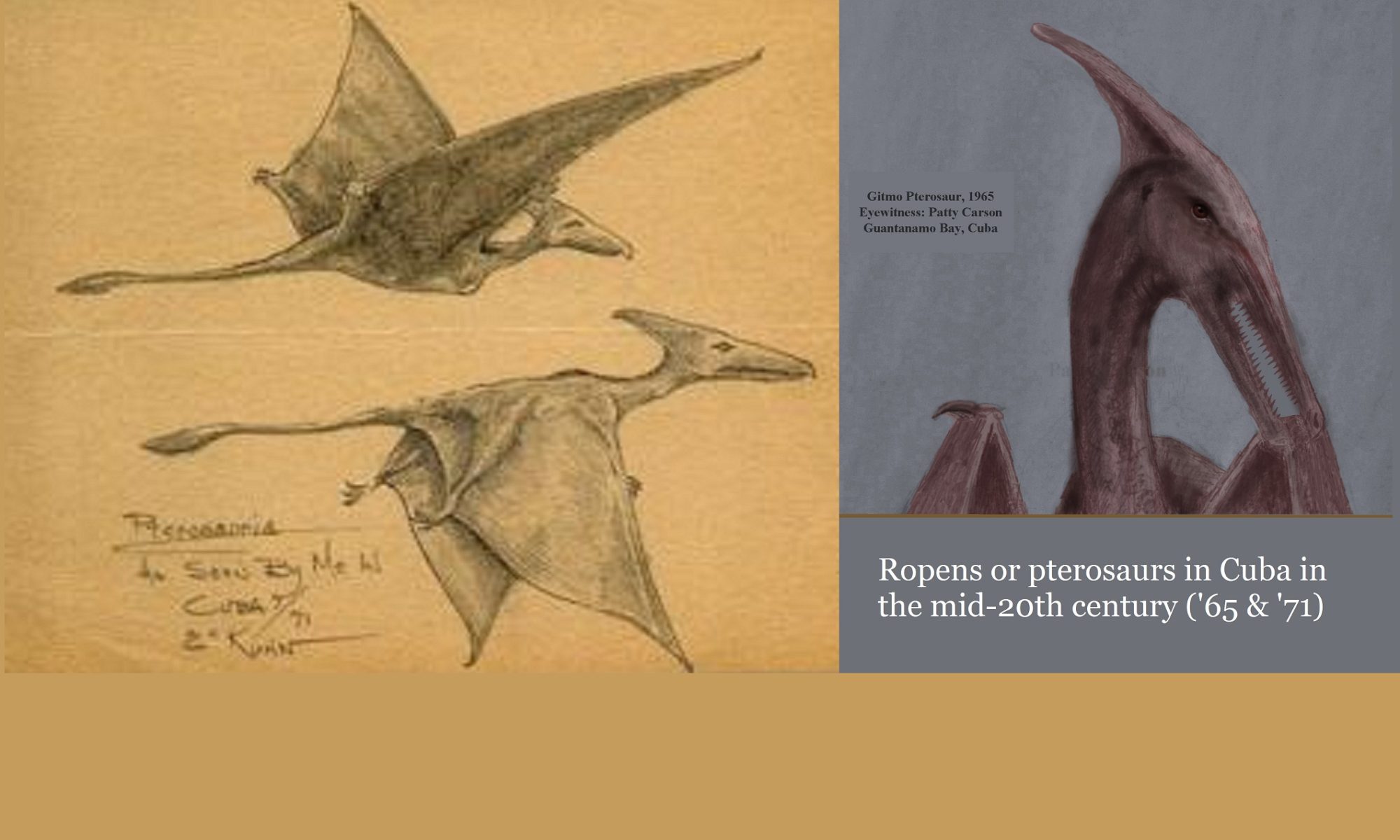
The kongamato is sometimes compared with the ropen of Papua New Guinea or the long-tailed pterosaur seen in Eastern Cuba in the mid-20th century. This kind of cryptid has been reported in many parts of the world, including North America, Australia, Europe, and Africa.

Kongamato Crossing the Atlantic?

One species of crane flies over the Himalayan Mountains regularly, sometimes at an altitude of 30,000 feet. Large nocturnal pterosaurs, under the right wind conditions, could cross the Atlantic, from Africa. As more sighting reports come in from Africa and North America, we need to look at the possibility that some of the flying creatures on different sides of the Atlantic may be closely related or even the same species.

Books About Live Pterosaurs in North America

It seems we now have three nonfiction books about extant pterosaurs in North America . . . These paperback books are Big Bird (by Ken Gerhard), Live Pterosaurs in America (by Jonathan Whitcomb, third edition), and Bird From Hell (by Gerald McIsaac, second edition).

Books on extant pterosaurs are not so rare as they were when On the Track of Unknown Animals was first published.

*****************************************************************

Ad

Third edition of "Live Pterosaurs in America"

Get the details lacking on the online blog posts and web pages. Buy Live Pterosaurs in America, third edition, by the nonfiction author who interviews eyewitnesses from around the world, the live-pterosaur expert Jonathan David Whitcomb. Get the facts, eyewitness accounts from many U.S. states: California, New Mexico, Texas, Arkansas, Oklahoma, Georgia, Florida, South Carolina, Pennsylvania, Kentucky, Virginia, Kansas, Indiana, Ohio, Wisconsin, Michigan, Missouri, Kansas, New York, and other states.

From a review of the second edition of this cryptozoology book, on Amazon, by “stevie” (the third edition is slightly expanded, even better than the second edition):

“This is an updated review of the book and I am changing my rating to 5 stars. This book has been on my shelf for almost a year now. I pick it up every now and then and a part of me becomes more impressed by the book every time. . . .

“Whitcomb painstakingly reviews every account for credibility and reason. This man is not a crank. He tries to weed out would be hoaxes and miss-identification. This is not a guy looking to create evidence to confirm his own beliefs. On top of this, I have great respect for a guy who follows his dreams so passionately. He has traveled to Papua New Guinea to search for the creature there and this book is somewhat of a sequel . . .

“I do believe the author tried hard to deliver these stories and was very good at it. This is well written and very hard to put down.”

Switch to our mobile site