Live Pterosaur

|

Investigating Reports of Living Pterosaurs, by Jonathan Whitcomb

Strange Flying Creature

December 15th, 2011

Bioluminescence in Pennsylvania: A Strange Flying Creature Glowing

A few weeks ago, I received an email from a lady who was a passenger in a car one night; both driver and passenger saw a glowing creature as the strange thing flew by. Afterwards she did some research and told me, “I have found that a pterosaur is identical to what we saw.” She has not yet told me any details about her research nor what image she may have seen that looked like what was encountered; but it is sufficient to consider that it was a possible American ropen. The sighting was in Pennsylvania, and I believe it involved bioluminescence.

She also mentioned that the flying creature ”was not too terribly high off the ground” and that it was ”quite large and seemed to be lit or glowing. . . . It was one of the strangest things I have ever seen.” She is one of the few eyewitnesses who have reported both a form of an apparent living pterosaur and a glow coming from the creature: strange indeed.

Demon Flyer

That brings up the idea that “ropen” comes from two native words. A brief reflection makes that appear unlikely, for how could such a short word come from two words that mean “demon” and “flyer?” No, it is much more likely that the original meaning of the word was something like ”flyer.”

Strange Flying Creatures and Bulverism

“Bulverism” C. S. Lewis labeled the slick ploy of avoiding reasoning on a subject by pointing out the reason ones opponent is so silly. Do some criticisms of living-pterosaur investigations qualify as bulverism? I believe so.

Let us not make the mistake of some critics. When eyewitnesses report something strange, and the reports have similarities, we need not reject all the reports simply because they appear strange. In this wonderful world in which we live, some creatures appear strange, including some creatures that fly.

Combining “Strange” and “Like a Pterosaur”

If at least some modern pterosaurs have bioluminescence, why do we have so few sighting reports of glowing pterosaurs? Simply combine the two: uncommon modern pterosaurs and brief bioluminescent flashes. When two things are uncommon, the probability of observing both of them together is more rare. But there is more going on hear than just multiplying two improbabilities together. In our Western society, what would happen if somebody reported seeing a glowing pterodactyl? It would sound much too weird, like a fire breathing dragon or like a . . . well . . . a glowing pterodactyl. In Western countries like the United States, we would not expect many eyewitnesses to report a luminous pterosaur to a newspaper, and few newpapers would print that kind of thing; but if a nonfiction author wrote books about that kind of thing, then a few eyewitnesses would send him their reports. That is what has happened to me, since I started writing my books. And I pay attention.

Newspaper Articles on Pterosaur Sightings

December 13th, 2011

Does anyone have a newspaper article to share? It could be an old one, but please, not the nineteenth-century ones about the pterosaur breaking out of a tunnel in Europe or the cowboys who shot one in Arizona; we need more recent accounts.

Newspaper Articles – Live Pterosaur Media Center

The Houston Chronicle, by circulation the ninth largest newspaper in the United States, pulled away the welcome mat to “flying dinosaurs” that might want to fly over southwest Texas; it emphasized Whitcomb’s lack of credentials and experience. But “What’s going on in Marfa?” (December 19, 2010 issue) was elicited by the press release “Unmasking a Flying Predator in Texas,” which was written by Whitcomb after he had received, over several years, eyewitness reports of apparent living pterosaurs in Texas, from citizens of Texas. The Houston Chronicle writer failed to mention that.

This Houston Chronicle article deserves attention, although I had previously written about it briefly on this blog (Dinosaur Bird post). Before getting into details, I emphasize that I am grateful that “What’s going on in Marfa” was published by that newspaper, for it may have given at least a few readers the opportunity to consider the possibility of modern living pterosaurs, or at least to know that some people take it seriously.

Unfortunately, the staff writer for the Houston Chronicle, Claudia Feldman, did not take my cryptozoological hypothesis seriously. She asked me about my education and about my ideas about Marfa Lights, but appeared to set aside the sightings that make up the foundation of my investigations. Considering the politics of major news media, this should not be surprising. Any idea contrary to the beliefs of the great majority of newspaper readers—that is rarely taken seriously unless ample or obvious evidence appears in other news reports. What media writer would want to take a serious risk of censure? The idea that glowing pterosaurs live in Texas—that can too easily appear too paranormal to most news writers. That said, I feel that Feldman made a serious error in neglecting the many eyewitness accounts, reports from citizens of Texas who have encountered apparent pterosaurs; I have interviewed some of them myself, and have found them to be credible.

Front Page News – Live Pterosaur

The Antwerp Bee-Argus was more kind to the possibility of live pterosaurs. The August 5, 2009, issue of this weekly newspaper in Ohio gave the subject the front page, unfortunately misspelling “pterosaur” in the title, but giving an open-minded approach to a strange sighting by a local man.

Few major newspapers have published eyewitnesses accounts of apparent living-pterosaurs, at least in recent years. As reported in the Antwerp Bee-Argus, they “have been thought by many scientists to have gone extinct many millions of years ago,” that is, the pterosaurs, not yet major newspapers.

Ropen: a Demon Flyer?

December 10th, 2011
Lake Pung on Umboi Island in Papua New Guinea

Lake Pung, Umboi Island, Papua New Guinea, where the ropen ("demon flyer" or not) sometimes flies

The book Mysterious Creatures, A Guide to Cryptozoology, by George M. Eberhart, includes this entry under the “Ropen” title: “An Austronesian word said to mean ‘demon flyer.’” That may be partially correct but easily misleading. Most of the sources for Eberhart’s Ropen entry are the writings of Karl Shuker in Fortean Times articles, dated in the years 2000, 2001, and 2002. Without reading those articles I will not speculate on them. But my associates and I who have explored in Papua New Guinea more recently and have interviewed many natives—we may have had opportunities more extensive than Shuker’s, or at least have had the potential for new insights.

Austronesian is a language family, not a language; individual languages of this family are found on many islands, including many in Papua New Guinea. Among the hundreds of languages spoken in Papua New Guinea, Kovai (spoken in some villages of Umboi Island) is Papuan, according to Wikipedia; it is not Austronesian. But the word “ropen,” for a large flying cryptid that sometimes glows as it flies at night—that word comes from those villages that speak Kovai.

The second Umboi Island expedition of 2004 (a few weeks after mine) turned up an interesting perspective on the word “ropen.” Jacob Kepas, the native interpreter for the American cryptozoologists David Woetzel and Garth Guessman, knew the word but was puzzled. Why go to such trouble flying on a small plane to Umboi Island to search for a bird? In his village near Wau (mainland Papua New Guinea), “ropen” is the word used for a common bird. The large nocturnal flying creature that glows—that frightening creature they call “seklo-bali.”

So in those two small areas of Papua New Guinea (villages of Umboi Island including Opai and Gomlongon, and at least one village near Wau on the mainland) the meaning of the word “ropen” differs greatly. An examination of the expedition reports from American cryptozoologists who have searched for living pterosaurs in Papua New Guinea in the 1990′s and early twenty-first century—that reveals that the Western-world usage of ”ropen” comes from the Kovai-speaking islanders of Opai and Gomlongon.

A casual observation of the “Demon Flyer” episode of MonsterQuest on television is a world apart from reading Shuker’s article or Eberhart’s book or one of my books. Monsterquest episodes are mini-adventure-shows, not scientific documentaries, so we are not surprised at a few technical innacuracies; but innaccuracies are hardly confined to television adventure shows. Search with the phrase (in quotes) “demon flyer” and one of the first-page results from Google can take you to a page with the following:

Just off the eastern coast of Papua New Guinea . . . are the small islands of Rambunzo and Umboi. These two islands are said to be the home of the Ropen, which when translated from the indigenous dialect literally means, Demon Flyer.

Let us examine that declaration.

First, a brief Google search makes me suspect that the island of ”Rambunzo,” by that spelling, does not exist in Papua New Guinea; perhaps it is a misspelling, for the first few pages of Google searching refer to cryptozoology sites and Wikipedia has nothing by that spelling. But if this is a misspelling of “Rambutyo,” ( near Manus Island) we need to consider what at least some of the people of the northern islands of Papua New Guinea call the large nocturnal flying creature : “kor.” My contact person in that part of PNG is clear about that word for what Umboi Islanders (to the south) call “ropen.” “Kor” is their word, which I suspect is used by the people of Rambutyo. In addition, I don’t recall ever writing anything about “Rambunzo,” in any of my web pages from 2003 to late-2011, in spite of what one web site declares about my involvement with that word.

Second, Rambutyo (as the correct spelling for the nonexistent ”Rambunzo”), which is actually northeast of the mainland, is smaller than Umboi, but many people would not call Umboi, at 900 square kilometers, ”small.” In addition, many islands, of various sizes, are east and northeast of the mainland; why single out those two? The large nocturnal flying creatures, called by various names in various languages, can be seen (although mostly at night by their bioluminescence) around and over many islands of Papua New Guinea, not just over or near Rambutyo and Umboi.

Third, there is no “indigenous dialect” for these two islands. In fact, I was told by Delilah Kau (or “Kow”), wife of the government-and-local-village leader Mark Kau, that several nearby villages around Gomlongon have different “languages.” She probably referred to what we would call different dialects of Kovai, but other villages of Umboi, not so close to Gomlongon, really do have different languages. Even if islanders of Rambutyo all spoke the same language, it would be very unlikely to be the same dialect (even if the same language) as any on Umboi Island.

That brings up the idea that “ropen” comes from two native words. A brief reflection makes that appear unlikely, for how could such a short word come from two words that mean “demon” and “flyer?” No, it is much more likely that the original meaning of the word was something like ”flyer.”

Pterosaur Wingspan, Recent Statistics, Absence of Hoaxes

December 7th, 2011
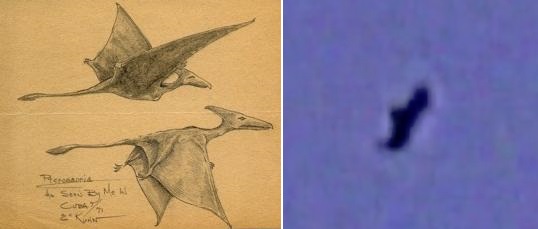
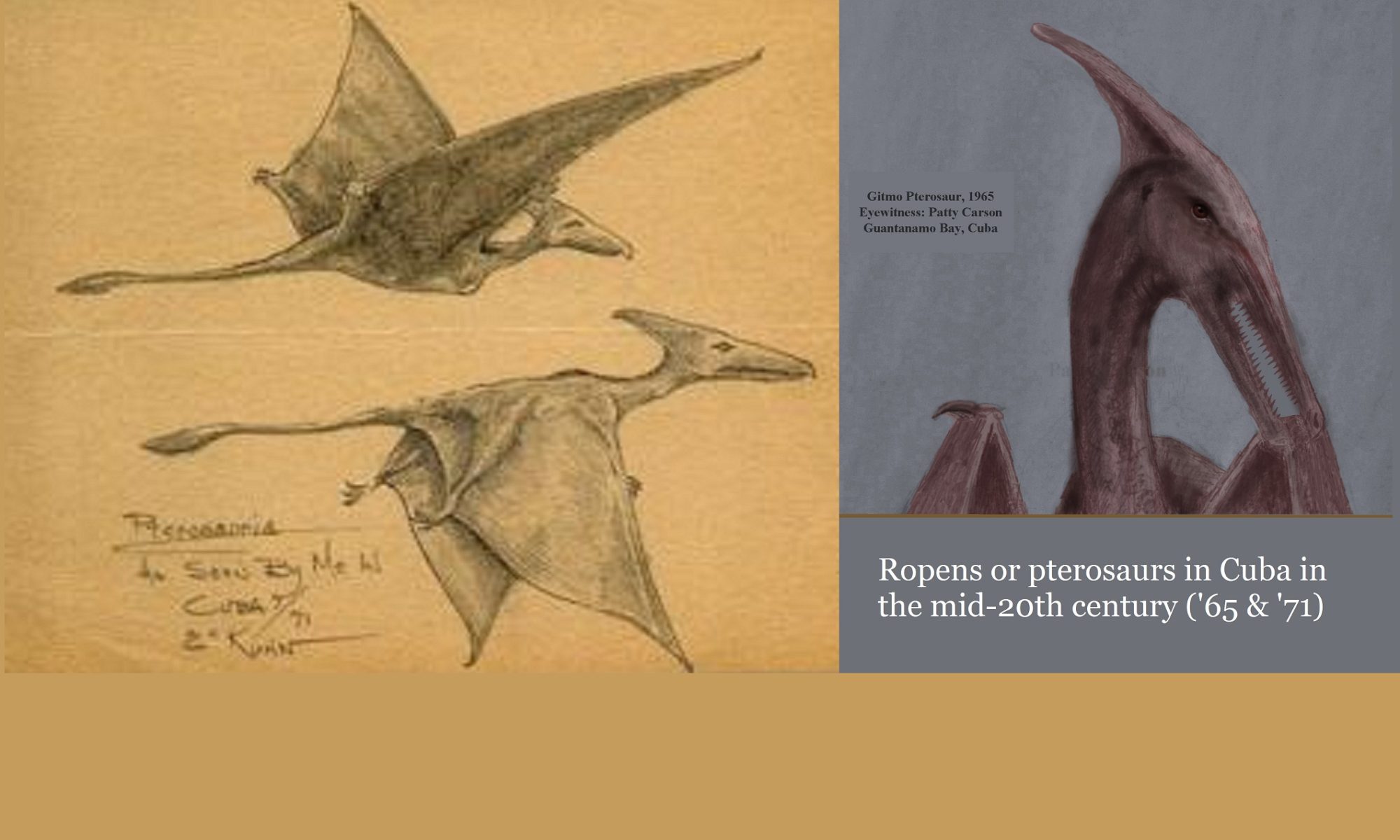
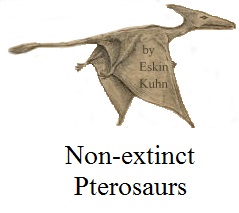
Perosaur Sketch by Eskin Kuhn

Kuhn saw two pterosaurs in Cuba, in 1971

After compiling data and analyzing what many eyewitnesses have reported, over many years, I found that the larger data now available supports the earlier conclusion that a hoax or hoaxes played no significant part in the reports. We now consider the wingspan estimates.

But first we review this perspective: A number of species of pterosaurs (more than two) live in many areas of this planet, with at least most of them being at least mostly nocturnal and with some of them being witnessed by people in counties in which universal dinosaur and pterosaur extinction is taken for granted. These species include both Pterodactyloids and Rhamphorhynchoids. For Westerners unfamiliar with the past seventeen years of cryptozoological investigations of apparent living pterosaurs, this perspective can appear too incredible to consider, but the data on wingspan estimates is in harmony with it and out of harmony with any reference to potential hoaxes.

The recent data comes from 98 sightings, in fourteen countries on five continents (plus two sightings over two seas), with 57 of them including estimates for wingspan. The critical point is that the wingspan estimates are fairly evenly distributed from two feet to forty-six feet. Since these are estimates, not measurements, and the sightings were in various countries of the world and under various conditions (and from eyewitnesses with various skills in estimating wingspans), we could expect a wide range of evenly spaced values, especially within the perspective of a number of species that may have a number of common adult-sizes. That is what we see in this data.

But we would not expect so much of an even spacing if hoaxes played a major part in the sighting reports. Why? Because of commonly-held beliefs about what a modern pterosaur should be like, especially in Western countries (and 68% of these sightings were in the USA).

Let’s consider why somebody would want to perpetrate a hoax: To shock somebody who would believe the hoaxer’s story. That means that at least one thing in the story needs to be shocking, but the story also needs to somehow be believable to somebody. Should somebody fabricate a story about a modern pterosaur, and supply an “estimate” of the wingspan, what would that hoaxer fabricate? The wingspan would need to be big enough to be shocking, but not too big. What about fabricating a wingspan of something around nine to thirteen feet? No, that would not do for a fraud, for it is too close to resembling a large bird, and the potential hoax-victim might say it was a misidentified bird. A hoaxer would more likely choose a wingspan from seventeen feet to twenty-one feet: shocking but not too unbelievable, and not as likely taken for a misidentified bird.

But statistics rule out hoaxes as a significant explanation for pterosaur sightings, for 26% of the 57 reports were of wingspans from nine to thirteen feet and 16% were from seventeen feet to twenty-one feet. If we look at eight-to-twelve-feet, instead, we get 21%; with sixteen-to-twenty-feet giving us 18% of total sighting reports: far different from what we would see from significant hoaxing.

Modern Pterosaurs in Cuba

The sketch of two living pterosaurs (shown above) was drawn by the eyewitness Eskin Kuhn, minutes after his 1971 encounter in Cuba (Gitmo).

Switch to our mobile site