

By Jonathan Whitcomb
How common are reports of long tails on apparent modern pterosaurs! We now begin with a report from Sudan, Africa, as I wrote in the fourth edition of my book Searching for Ropens and Finding God (page 152):
Flying Creature in Africa
I received another email, one directly from an eyewitness himself:
“In Sudan the classic house is one level made of mud bricks and walls, 3-5 rooms, 1-2 bathrooms and a kitchen, each room being a separate unit, but connected by a roofless hallway that leads to the patios.
“One evening in July of 1988, we had some guest over the house. . . . The guest were in the living room which was at one end of the house . . . I took the tray [of cookies and tea] walked through the open hallway and proceeded to the living room.
“When I got to the patio, I noticed something on the roof of my uncle’s room. . . . I was standing by the bathroom, about 10 feet away from it. . . . I seen it very clearly . . .
“It was very large, about 4 or 5 feet in height. It was an olive brown color, no feathers. It was leathery looking.. . . It had really large black claws and its tail looked like a lion’s tail . . . very long and had a bushy or hairy tip.
.
Ropen Sightings in Papua New Guinea
During my expedition on Umboi Island, in the southwest Pacific in 2004, I was fortunate to interview three young men deep in the interior of that island. They were in a group of seven native boys, about ten years earlier, who had a shocking encounter with a gigantic ropen. Soon after arriving at the crater lake Pung, in the middle of the day, the creature flew over the surface of that lake.
While questioning Gideon Koro, I asked how long the tail was: He said, “seven meetuh” (7 meters or 23 feet). His brother Wesley later told me that the ropen they had encountered was “too big”.
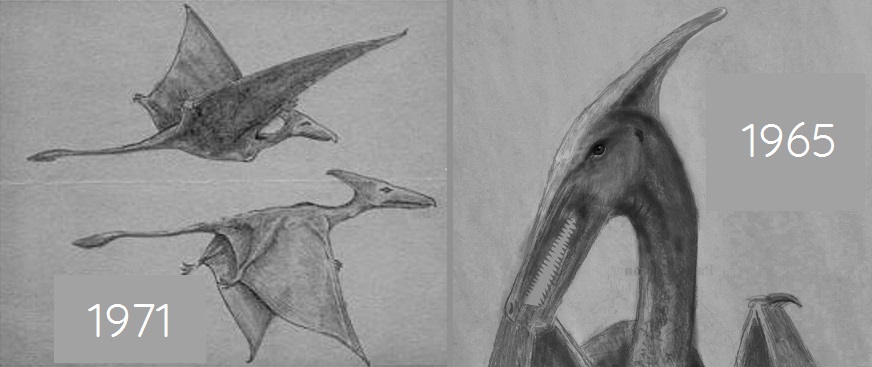
Non-native eyewitnesses in Papua New Guinea have also described a long tail on an apparent “pterodactyl” or “prehistoric” flying creature. Duane Hodgkinson, in 1944, saw one with a tail he estimated to have been “at least ten or fifteen feet” long. Brian Hennessy’s creature (1971) had a tail that he described as “longish narrow”.
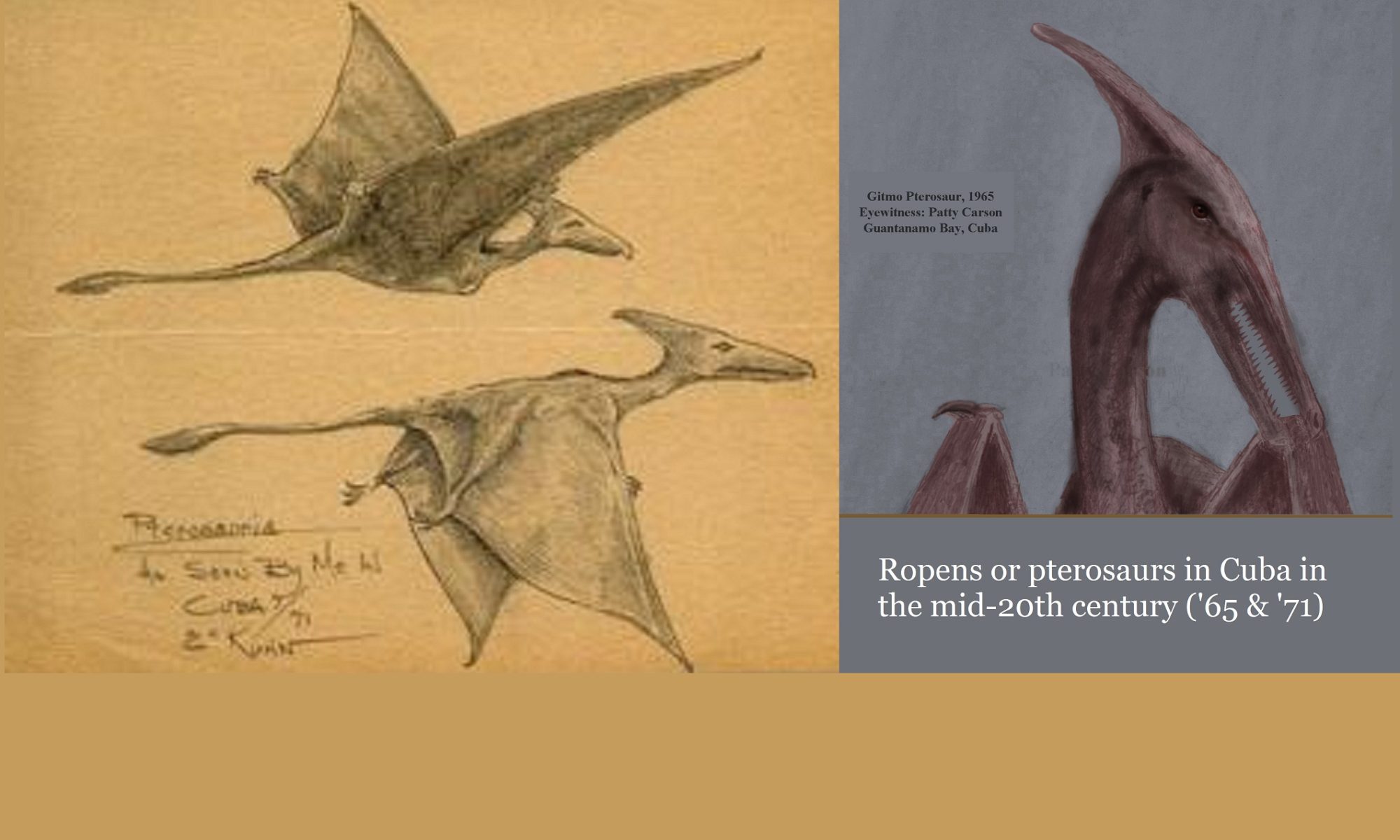
Other eyewitnesses, in many areas of the world, often describe apparent pterosaurs as having long tails. In addition, many of those persons also saw some kind of appendage at the end of the tail.
.
Conclusion
It seems that at least one species of Rhamphorhynchoid pterosaur lives in many areas of the planet. These flying creatures are generally nocturnal and rare in any particular area at any particular time.
.
###
.
Within a few weeks after my return to the United States, two other Americans searched that same island for the ropen. They were able to explore areas in the north, where I had not been, and interview natives that I had not been able to contact.
.
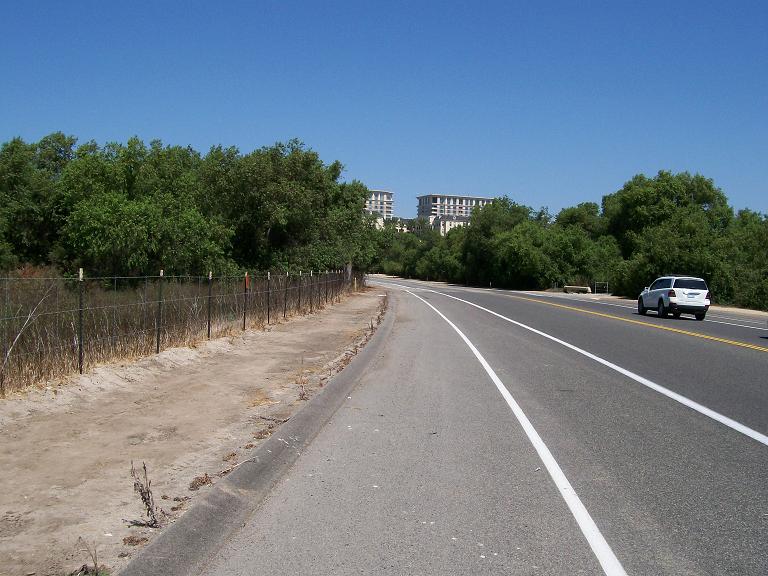
In 2007, a businessman encountered a gigantic pterosaur as it flew in front of his car in Irvine, California, near the university, according to what he reported to me. The tail alone was about 15 feet long . . .
.
Flying creature with a long tail
Eyewitnesses from around the world testify of the featherless flying creatures that they have observed, unlike any bat and obviously not any bird.
.
Rhamphorhynchoid sighting in Minnesota
Three of us seen it. It was just turning light and it was gliding over a two lane road in front of the truck headed for a swampy area in Minnesota. . . . The teeth were all sharp, yes that’s how close we were. It had a spade tail as long as its body and a crest on its head with wings like a bat. Its color was reddish brown.
.
Living pterosaur in the United States
How could they now be living in California, Texas, Florida, South Carolina, Ohio, New York, and many other states? Did not pterosaurs become extinct millions of years ago? Cryptozoology is the study of reports of creatures (or apparent creatures) whose descriptions suggest something other than animals classified by standard biology as extant.
.
Cognitive bias and living pterosaurs
Jonathan Whitcomb, executive director of Animal Discovery in Utah, suggests why a few professional paleontologists, along with some amateurs, have loudly objected to conclusions from investigators of eyewitness accounts of apparent non-extinct pterosaurs: “Most likely they’re afraid that public respect for traditional paleontology may be damaged.”
.
Eyewitnesses from around the world testify of the featherless flying creatures that they have observed, unlike any bat and obviously not any bird.
.
In 2007, I was on Bragg Street and I heard the trees ruffle and that same thing flew from one side of the street to the other. It was beside the bike trail before you get to Central Women’s Prison. I knew I wasn’t crazy: This time a guy at the other end looking towards me saw it [at] the same time. We just stared and both said, “Did you see that?”
.
This page contains hundreds of references to sightings of apparent living pterosaurs, accounts from around the world.
.
Featherless flying reptiles appear to live across the globe, shocking and sometimes frightening eyewitnesses of these apparent modern pterosaurs. The animals are also called “pterodactyls” or even “flying dinosaurs” or “dinosaur birds”.
If it has a long tail, it is called “ropen”, but in some areas of Africa this reptile-creature is known as “kongamato”.
.
It is a strange description, to be sure, that combination of a head crest and a Rhamphorhynchoid-like tail that has a structure at tail-end. It appears almost as strange as a description of a platypus, to someone who knows about mammals and ducks but who has been ignorant of that strange animal that now lives in Australia.
.
Communicate with the cryptozoologist
.