On the Youtube channel “Protect Animal Life”, the compilation video “Flying Dinosaurs – Modern Pterodactyls ALIVE” (FDMPA) features twenty sightings: excerpts from eight videos. I highly recommend watching that 26-minute video to get an overview of the living-pterosaur branch of cryptozoology.
Thumbnail for the FDMPA video on Youtube
A “Pterodactyl” Sighting in Rome, Italy, in 2019
Here is the subtitle-text from the first encounter featured in this video:
In the words of an eyewitness, “It had a long tail that fanned out at the tip. It was close to the Colosseum. . . around 10 p.m.”
“My girlfriend also witnessed this creature. It was about the size of a man: membrane type wings . . . gliding, not flapping its wings. Went back and forth three times.”
Two kongamatos encountered in Kenya, Africa, in 1969
A 14-year-old boy witnessed two long-tailed flying creatures during an expedition with his father. He estimated their wingspans at between 24 and 36 feet. At the time, he kept quiet, fearing he would be laughed at.
How common are reports of long tails on apparent modern pterosaurs! We now begin with a report from Sudan, Africa, as I wrote in the fourth edition of my book Searching for Ropens and Finding God (page 152)
[Availability cascade] is a self-reinforcing activity whereby a belief, in people of a culture or community, gains more and more popularity through repetition. How does this relate to sightings of apparent living pterosaurs in the United States? It’s in extinction indoctrination.
Two decades ago, a man started writing a web page criticizing the idea that not all species of pterosaurs are extinct. He often added to that page and mentioned my name many times. He expanded it so often, over the years, that the word count, as of earlier this week, was 40,676. How gigantic at 40 thousand words on that one online post! And how unique, mentioning my name (“Whitcomb”) 493 times!
The point is this: He was trying to defend old standard models of geology.
These are excerpts from the ten most popular living-pterosaur videos on this channel (Protect Animal Life) in 2022, ending with the #1 most-viewed. Watch the full videos: . . .
A nonfiction-cryptozoology author has analyzed reports of non-extinct pterosaurs, commonly called “pterodactyls” or “flying dinosaurs,” and found how sightings relate to thirty-three states (and Washington D.C.) of the United States. Jonathan Whitcomb, of Murray, Utah, has been receiving emails, and an occasional phone call, over a period of 13 years . . .
The Houston Chronicle, by circulation the ninth largest newspaper in the United States, pulled away the welcome mat to “flying dinosaurs” that might want to fly over southwest Texas; it emphasized Whitcomb’s lack of credentials and experience. But “What’s going on in Marfa?” (December 19, 2010 issue) was elicited by the press release “Unmasking a Flying Predator in Texas,” which was written by Whitcomb after he had received, over several years, eyewitness reports of apparent living pterosaurs in Texas, from citizens of Texas. The Houston Chronicle writer failed to mention that.
How common are reports of long tails on apparent modern pterosaurs! We now begin with a report from Sudan, Africa, as I wrote in the fourth edition of my book Searching for Ropens and Finding God (page 152):
Flying Creature in Africa
I received another email, one directly from an eyewitness himself:
“In Sudan the classic house is one level made of mud bricks and walls, 3-5 rooms, 1-2 bathrooms and a kitchen, each room being a separate unit, but connected by a roofless hallway that leads to the patios.
“One evening in July of 1988, we had some guest over the house. . . . The guest were in the living room which was at one end of the house . . . I took the tray [of cookies and tea] walked through the open hallway and proceeded to the living room.
“When I got to the patio, I noticed something on the roof of my uncle’s room. . . . I was standing by the bathroom, about 10 feet away from it. . . . I seen it very clearly . . .
“It was very large, about 4 or 5 feet in height. It was an olive brown color, no feathers. It was leathery looking.. . . It had really large black claws and its tail looked like a lion’s tail . . . very long and had a bushy or hairy tip.
.
Ropen Sightings in Papua New Guinea
During my expedition on Umboi Island, in the southwest Pacific in 2004, I was fortunate to interview three young men deep in the interior of that island. They were in a group of seven native boys, about ten years earlier, who had a shocking encounter with a gigantic ropen. Soon after arriving at the crater lake Pung, in the middle of the day, the creature flew over the surface of that lake.
While questioning Gideon Koro, I asked how long the tail was: He said, “seven meetuh” (7 meters or 23 feet). His brother Wesley later told me that the ropen they had encountered was “too big”.
Non-native eyewitnesses in Papua New Guinea have also described a long tail on an apparent “pterodactyl” or “prehistoric” flying creature. Duane Hodgkinson, in 1944, saw one with a tail he estimated to have been “at least ten or fifteen feet” long. Brian Hennessy’s creature (1971) had a tail that he described as “longish narrow”.
Other eyewitnesses, in many areas of the world, often describe apparent pterosaurs as having long tails. In addition, many of those persons also saw some kind of appendage at the end of the tail.
.
Conclusion
It seems that at least one species of Rhamphorhynchoid pterosaur lives in many areas of the planet. These flying creatures are generally nocturnal and rare in any particular area at any particular time.
Within a few weeks after my return to the United States, two other Americans searched that same island for the ropen. They were able to explore areas in the north, where I had not been, and interview natives that I had not been able to contact.
In 2007, a businessman encountered a gigantic pterosaur as it flew in front of his car in Irvine, California, near the university, according to what he reported to me. The tail alone was about 15 feet long . . .
Three of us seen it. It was just turning light and it was gliding over a two lane road in front of the truck headed for a swampy area in Minnesota. . . . The teeth were all sharp, yes that’s how close we were. It had a spade tail as long as its body and a crest on its head with wings like a bat. Its color was reddish brown.
How could they now be living in California, Texas, Florida, South Carolina, Ohio, New York, and many other states? Did not pterosaurs become extinct millions of years ago? Cryptozoology is the study of reports of creatures (or apparent creatures) whose descriptions suggest something other than animals classified by standard biology as extant.
Jonathan Whitcomb, executive director of Animal Discovery in Utah, suggests why a few professional paleontologists, along with some amateurs, have loudly objected to conclusions from investigators of eyewitness accounts of apparent non-extinct pterosaurs: “Most likely they’re afraid that public respect for traditional paleontology may be damaged.”
In 2007, I was on Bragg Street and I heard the trees ruffle and that same thing flew from one side of the street to the other. It was beside the bike trail before you get to Central Women’s Prison. I knew I wasn’t crazy: This time a guy at the other end looking towards me saw it [at] the same time. We just stared and both said, “Did you see that?”
Featherless flying reptiles appear to live across the globe, shocking and sometimes frightening eyewitnesses of these apparent modern pterosaurs. The animals are also called “pterodactyls” or even “flying dinosaurs” or “dinosaur birds”.
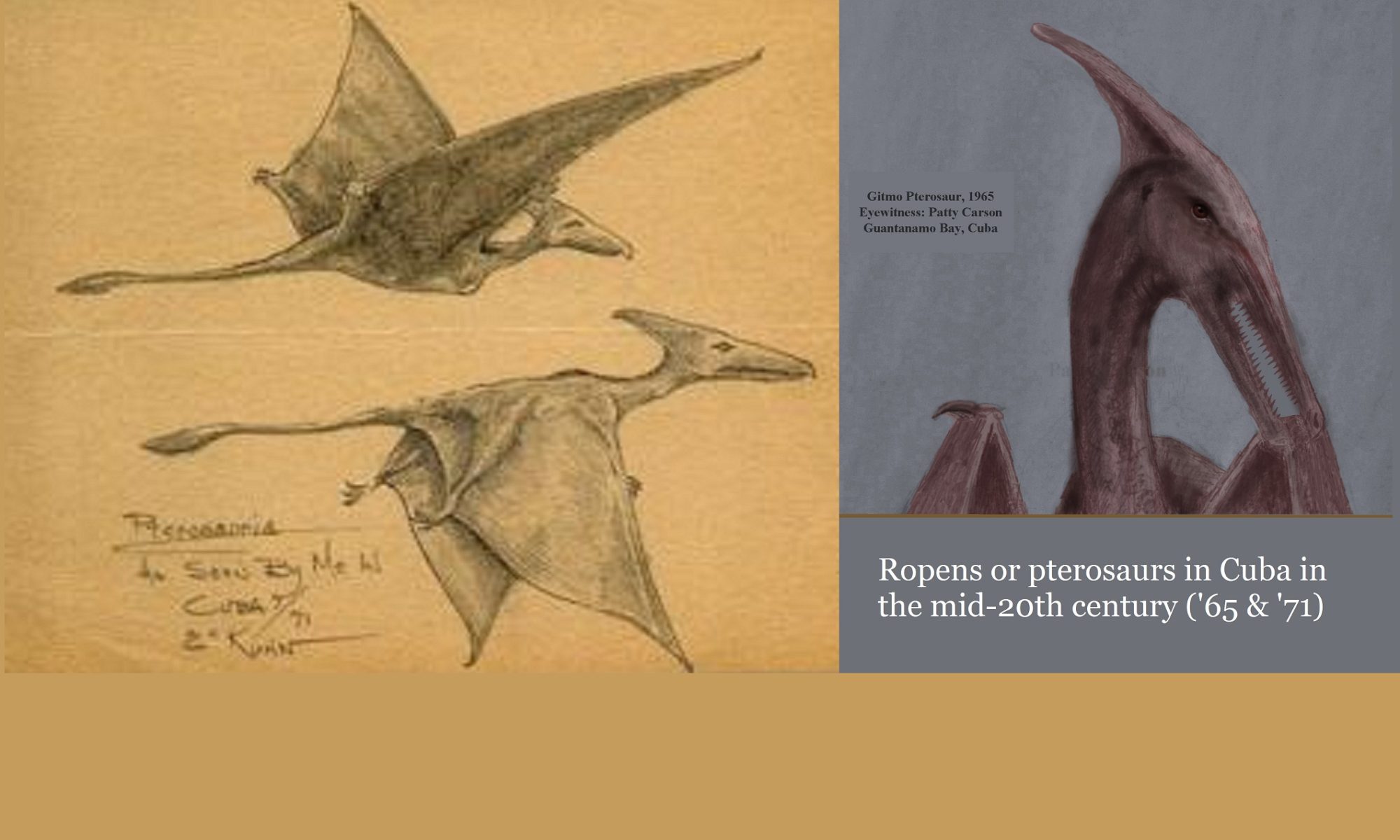
If it has a long tail, it is called “ropen”, but in some areas of Africa this reptile-creature is known as “kongamato”.
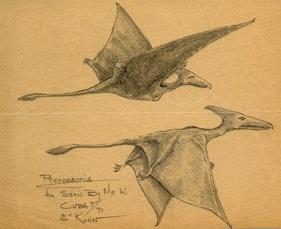
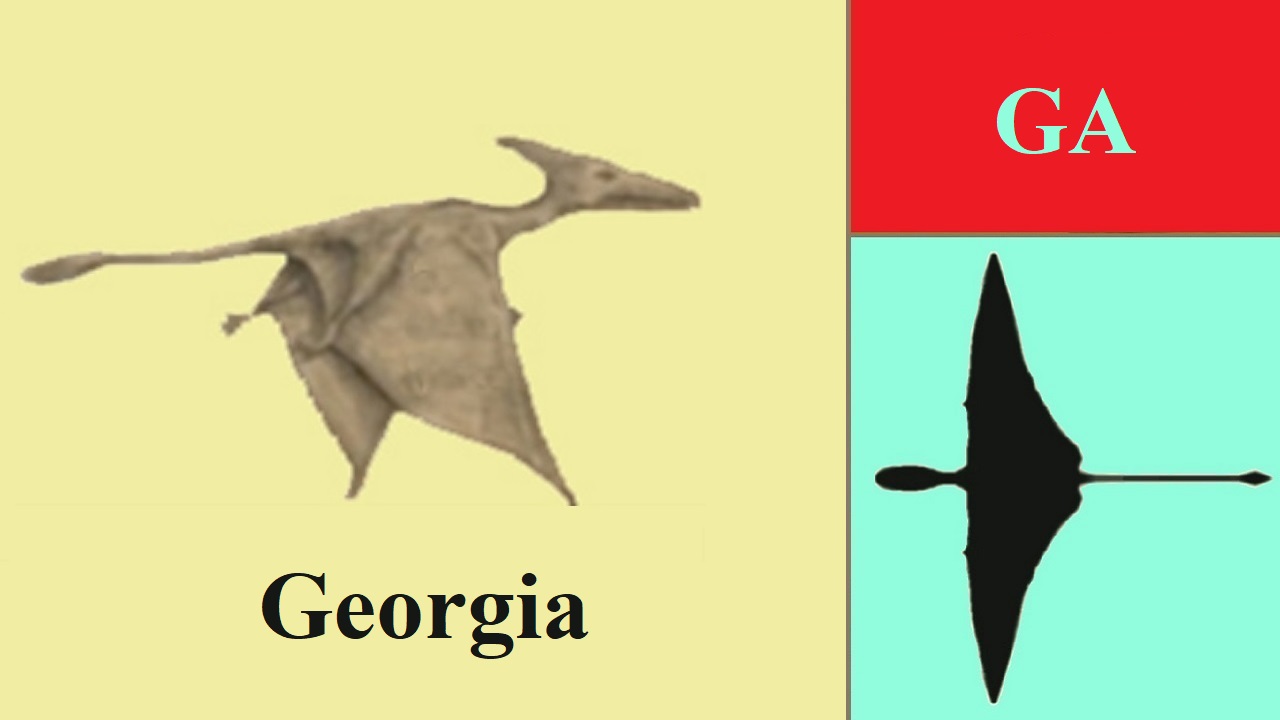
It is a strange description, to be sure, that combination of a head crest and a Rhamphorhynchoid-like tail that has a structure at tail-end. It appears almost as strange as a description of a platypus, to someone who knows about mammals and ducks but who has been ignorant of that strange animal that now lives in Australia.
Here are two lists: videos on the Youtube channel Protect Animal Life (in order of uploading first and then alphabetical — active videos on PAL as of early May 13, 2020). All but five of them are primarily about modern pterosaurs:
Living-pterosaur (LP) cryptozoology involves interviewing eyewitnesses of unusual flying creatures, analyzing details in those reports, and comparing various accounts. Sometimes a number of sightings occur in the same general area. Let’s look at the British Isles, an area mostly neglected in my previous writings about these wonderful flying creatures that are not extinct. In particular, we have many reports of dragons in England, earlier in history, and some of those accounts may have involved flying creatures that have been reported in recent generations.
Please be aware that one explanation that people may suggest is that ropens or non-ropen modern pterosaurs have flown from Africa to the British Isles. I now have not nearly enough knowledge to say anything about that potential connection between Africa and western Europe, so let’s put that aside for now.
.
Pterosaur Sightings in Western England in September of 2017
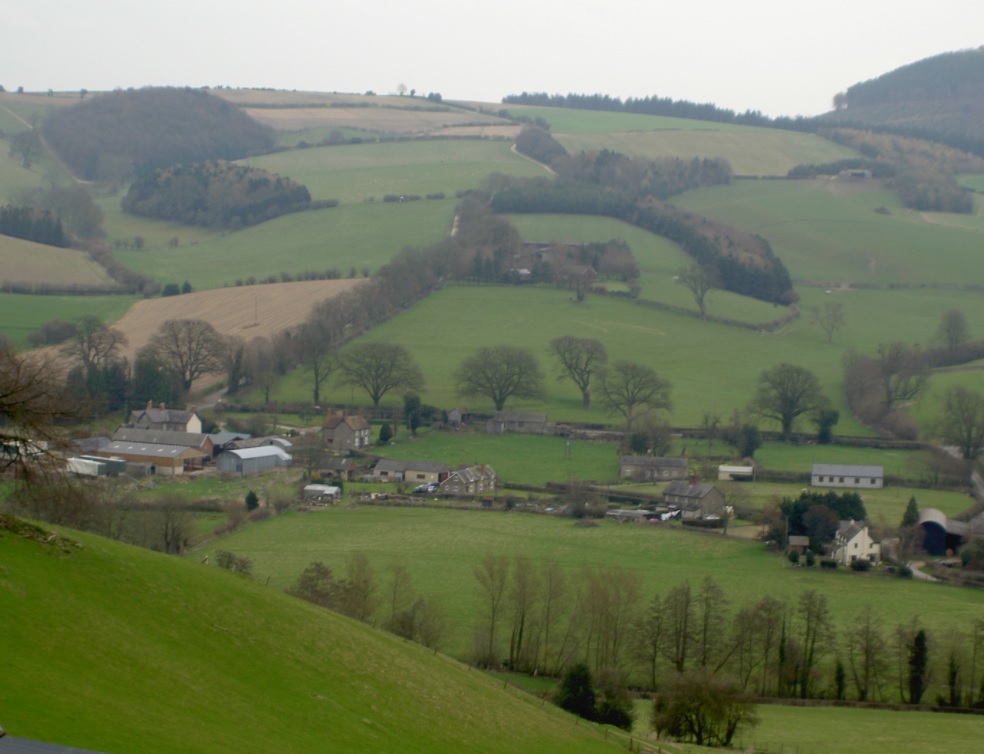
Whitchurch, the oldest continuously inhabited town in Shropshire, England, has a population of about 10,000 and is only two miles from the border with Wales. On September 27, 2017, I received an email from a lady who wishes to be anonymous but whose experience needs to be shared with the world. In one of the emails I sent her, I mentioned the possibility that some of the larger living pterosaurs may be dangerous to people.
Here is part of her account (slightly edited for punctuation, spelling, etc):
. . . I am in the best of health mentally. I do not take any form of narcotics nor prescription pills, and I do not drink. I am a God fearing women. . . . Two weeks ago around 9 a.m. . . . I went into the garden . . . we live near a wildlife reserve which has an abundance of birds and wildlife, including eagles and hawks, heron, geese, swans, etc. It’s usual for them to fly overhead, and I see them flying; you hear their calls and get familiar with sounds.
Well, on this particular morning I heard a very strange screech; I say strange as I had never heard it before, and it was very loud, almost resounding. I could hear it getting closer across the way from behind the trees. I was curious as to what the sound was, but nothing prepared me for what I actually saw.
I saw two pterodactyls, side by side, flying past the tree. Now at first I had to check myself, because the first thing I thought was “those are blooooody big birds, that’s no lie.” But what struck me was that it had a giant size beak and the wings had no feathers.
. . . this was huge and flew directly past [some crows, revealing size], so due to its size I could see it clearly although it went past fast due to the size of the clearing between the tree and the houses. It was grey in colour, both of them as far as I could tell.
I have [researched] every bird in England and even foreign birds that look similar, in case any had escaped, but the one thing is the sound. None of the birds sound like what I heard. I took a whole day pondering and wondering what it is I actually saw . . .
I thought perhaps it was a toy, yes they have some good toys, but they still look plastic and two dimensional unless at a great distance, even the ones that flap their wings. It didn’t flap its wings up and down like a toy. It was a very fluid motion even coming across in a down to side ways sweep. After a day of research I kept the information to myself except [for] my husband, who remained skeptical but listened very nicely.
I may also add that it did not have [that I noticed] a lump on it head. So that is my story, however last weekend two of my children were playing in the garden . . . around 10 a.m. [and] my son of 13 years came running in to me saying he saw a giant big brown bird with giant wings.
He did have a look of fright or concern on his face, so I knew he wasn’t trying to pull my leg or was exaggerating. My younger daughter, who is nine, was with him and she said she didn’t see it, as she was playing by the trees, but she heard its sound. I asked her the sound (she happens to be a very good mimic when it comes to animals), and she made the sound that I had heard.
[For] the screech sound, the only thing that has come close is on Youtube: a pterodactyl sound clip. I went through pictures of birds with my son; he said it was bigger than the eagles which usually fly around the area. He said it was brown with very long wings. I asked him [if] it have feathers; he said he doesn’t know, he only saw it for a moment. So . . . [I] showed him a [picture of a] pterodactyl and he said, “Yes, that’s what it looked like.”
What I saw had no feathers and its wings were almost bat shaped. I had hoped someone else had seen it or it may have been reported, but as to date no one has. I have done much research online and the largest heron here still does not compare to what I saw: The legs are not long enough and the beak is not as big and the feathers are a major factor here.
I cannot explain what I saw. It was something like out of a movie but it was so quick I still disbelieve what I saw, and at the same time I know what I have seen. I do not know how something like that flying around was not seen by anyone else, as it was low flying, or how it could hide, but what I have told you is true.
Kind Regards . . .
.
“Bridgenorth, Shropshire” by Paul Sandby (1731-1809)
.
I replied:
Thank you
I was fortunate to be able to pass through your area of England in 1972 and still hope to return some day.
I know it can be a shock to see this kind of flying creature: We’re taught from early childhood that all of them became extinct long ago. My associates and I hope that these animals will be acknowledged by Western science before long. My own research has been ongoing for most of the past 13 years. We have an expedition ready to start in Papua New Guinea, where these flying creatures are best known and most commonly acknowledged. I will not be able to go along myself but I am grateful that I’ve been able to do just a little bit in supporting it this year.
Let’s begin with what my associates and I know. The animals are indeed real and very much non-extinct. One common name that many people use for them in the USA and in many English-speaking nations is “pterodactyl.” The proper word among scientists is “pterosaur,” but let’s not worry about that technicality.
We know, from many years of interviewing eyewitnesses in a number of areas of the world, that these modern species of pterosaurs are real, not from human imagination or hallucination. The two you saw, and the one seen by your son, have probably been seen by other persons in your area, but most people do not report their sightings, at least not to me or to one of my associates.
Since you have cats and children, I need to warn your family that at least some of the larger ones may sometimes be dangerous, although we still have much to learn.
I have a couple of questions:
1) Did any of the ones seen by your family have a long tail?
2) What is the online address (URL address) of the Youtube video that has a “pterodactyl sound clip?”
Thank you very much for reporting your sighting. It has been some time since I’ve gotten a report from your area.
Jonathan Whitcomb
The lady replied:
Dear Jonathan,
Thank you for your reply and information regarding pterosaurs.
This is the youtube clip with the sound, there are a number of them on youtube but this one comes closest to what I heard, although only up to four seconds as the second part of the sound I didn’t hear that.
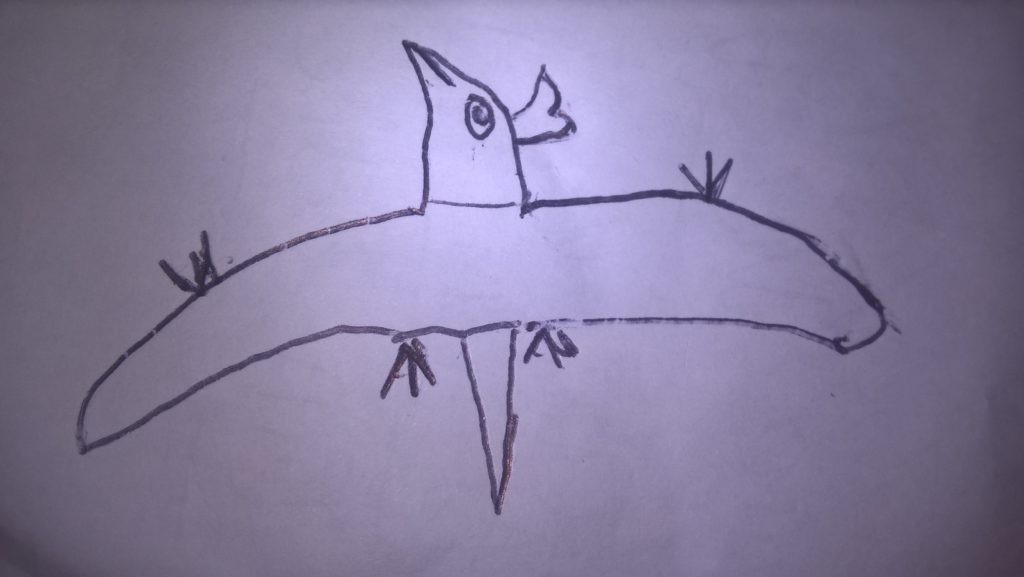
As for your question whether or not they had tails, this is my son’s interpretation of what he saw (he is not the best artist): He said it moved very fast like in stealth mode and was chasing one of the eagles or hawks around. He said it was 2-3 times the size of the bird it was chasing. I found a better image online but he said that it didn’t have such a big head crest part and the tail more like what he drew.
As for me, there was something trailing but I thought it was legs, but I didn’t really focus or notice as I was focused on its front, the beak and wings, and the time frame that I saw it was very quick. But to be honest I would say I saw legs rather than a tail. . . . It had very long wings.
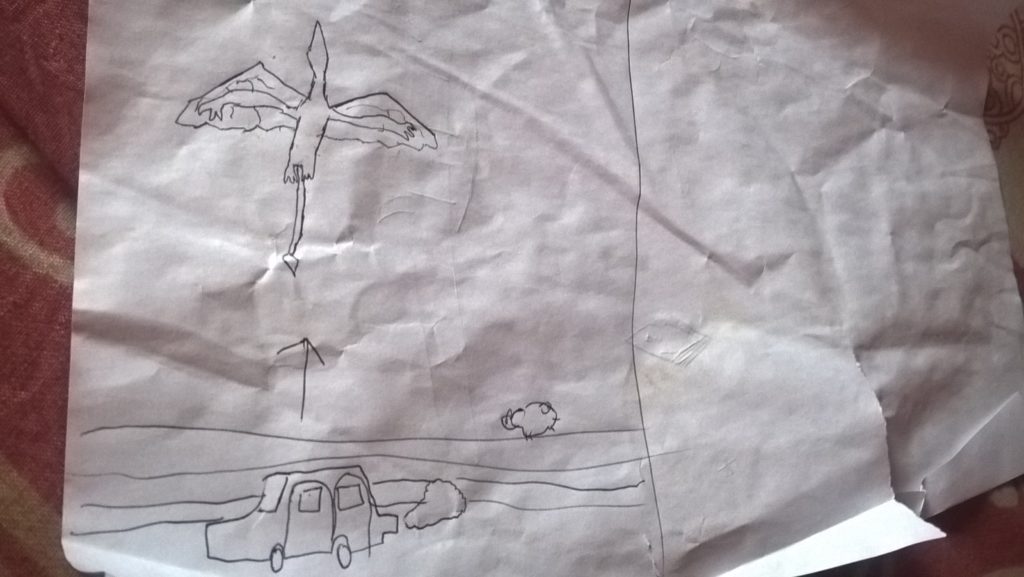
My daughter told me yesterday that on the way home from school she was looking out the window and where the sheep were she saw one flying in the sky. My husband did not see it as he was driving. It could be a heat of the moment thing as she is my youngest daughter of nine years, and you know how children can be sometimes, but she said she honestly saw it so thought I would mention it. I asked her to draw what she saw.
I hope that has been of help to you, I shall certainly keep a look out and let you know if I see anything else.
Kind Regards . . .
.
.
.
Shropshire, England
.
Concluding notes from Jonathan Whitcomb
We need to keep an open mind about ancient accounts of flying dragons in England and consider them in light of the more recent sightings of apparent pterosaurs.
How many critics have assumed that eyewitnesses of living pterosaurs must be either mistaken or dishonest! . . . I have interviewed eyewitnesses from many countries, including the United States, England, the Netherlands, Sudan, the Philippines, Papua New Guinea, Australia. Many of them describe a large flying creature with a long tail.
(by the cryptozoology author Jonathan David Whitcomb) I’m also grateful to Lon Strickler for allowing me here tp report a few sightings of apparent pterosaurs, but it deserves a brief introduction. This is a strange investigation in a narrow branch of cryptozoology.
“The extinction of some species of pterosaurs, out of so many known from fossils, is hardly disputed. The popular textbook declaration that all species became extinct millions of years ago, universal pterosaur extinction—that concept itself is approaching extinction.” Jonathan Whitcomb
Western indoctrination into the dogma of universal-extinction of all species of dinosaurs and pterosaurs has been so widespread for so many generations that any mention of the possibility of one species surviving to modern times is often met with extreme skepticism or worse.
. . . specific sighting reports have similar details, namely this: a large or giant size, a long tail with a Rhamphorhynchoid-like structure at the end, and a lack of feathers.
With each passing year, it becomes more obvious why many eyewitnesses of apparent living pterosaurs are credible and that the flying creatures observed are indeed modern pterosaurs. Many of the sightings are of obvious ropens, in other words modern Rhamphorhynchoids.